Featured Orthopedic & Surgical Instrumentation
Factory-direct OEM/ODM trauma fixation devices, powered surgical motors, anatomical skeleton models, and instrument sterilization cases conforming to CE and ISO 13485 manufacturing standards.

Biomechanics, Metallurgy & Structural Stability of Intramedullary Nailing
Understanding how load sharing, elastic modulus matching, and multi-planar locking dynamics reduce secondary displacement, nonunion, and cut-out risks in diaphyseal and metaphyseal fracture fixation.
Load-Sharing Mechanics
Unlike eccentric load-bearing bone plates that experience severe bending cantilever moments, intramedullary nails are situated directly within the neutral mechanical axis of long bones. By acting as internal splints, they permit early controlled axial micromotion (typically 0.2 mm to 1.0 mm), which stimulates robust secondary bone healing through external periosteal callus formation while safeguarding against catastrophic hardware fatigue.
Ti-6Al-4V ELI vs. 316LVM
Jiangsu GMV Medical produces intramedullary systems using ISO 5832-3 medical-grade Ti-6Al-4V ELI (Grade 23) and ISO 5832-1 vacuum-arc remelted 316LVM stainless steel. Titanium’s elastic modulus (~110 GPa) is substantially closer to cortical bone (~18-20 GPa) than stainless steel (~210 GPa), drastically curtailing stress-shielding, cortical thinning, and periprosthetic osteopenia during long-term patient recovery.
Multi-Planar Angular Stability
Modern distal targeting geometries incorporate multi-planar locking options, integrating coronal, sagittal, and oblique locking vectors. This geometric configuration prevents toggling, preserves rotational alignment in distal-third metaphyseal fractures, and prevents hardware migration even under vigorous early weight-bearing physiological regimens.
| Technical Parameter | Interlocking Intramedullary Nails (GMV) | Conventional Locking Bone Plates | External Fixators (Frame & Pin) |
|---|---|---|---|
| Mechanical Principle | Central intramedullary load sharing; minimal cantilever stress | Eccentric load bearing; high tension/bending bending moment | External bridging; cantilever or bilateral transfixation load |
| Periosteal Blood Supply | Fully preserved; minimal soft tissue dissection via closed entry | Partially compromised beneath plate footprint (even with LCP relief) | Completely preserved at fracture site; transfixing pin tracts |
| Callus Formation Mode | Enchondral secondary healing with dense bridging callus | Primary direct cortical healing (absolute rigidity) or asymmetric callus | Secondary callus formation under controlled compliance |
| Surgical Invasiveness | Minimally Invasive Surgery (MIS) through small proximal/distal incisions | Open reduction often required; extensive soft-tissue stripping | Percutaneous pin placement; no incision at fracture hematoma |
| Weight-Bearing Timeline | Immediate to early partial weight bearing tolerated in most patterns | Delayed progressive weight bearing until radiographic consolidation | Early mobilization; limited by pin-bone interface loosening |
| Infection & Revision Risk | Low deep infection rate (<1.5% in closed fractures); straightforward extraction | Higher infection risk in soft-tissue compromised zones; complex removal | Pin tract infection risk (10-30%); intended primarily for temporary damage control |
Clinical Recommendations for Intramedullary Fixation
Engineered to address complex diaphyseal nonunions, subtrochanteric comminutions, and periarticular long-bone fractures across adult and pediatric orthopedics.
PFNA Proximal Femoral Nail
Optimized for intertrochanteric (AO/OTA 31-A1 to A3) fractures. Features a helical antirotation blade that compacts cancellous bone rather than removing it, increasing cut-out resistance by over 45% in osteoporotic bone beds.
Expert Tibial Nail (ETN)
Designed with Herzog anterior bend (10.5°) for ergonomic proximal insertion. Features multi-directional proximal and distal locking configurations enabling stable fixation within 2.5 cm of the distal articular plafond.
Antegrade / Retrograde Femur
Universal bow design mimicking the anatomical 1.5m to 2.0m radius of femoral curvature. Enables versatile insertion through either the piriformis fossa / trochanteric tip (antegrade) or intercondylar notch (retrograde).
Humeral Interlocking Nail
Tailored for proximal and shaft humeral fractures with low-profile countersunk proximal locking caps that eliminate subacromial impingement and supraspinatus tendon abrasion during shoulder articulation.
Future Procurement Trends in Orthopedic Traumatology (2025–2030)
Shifting reimbursement dynamics, stringent MDR (EU) 2017/745 regulatory governance, and value-based purchasing are redefining supplier qualification criteria worldwide.
MDR 2017/745 Documentation
International hospital tenders across the European Union, the Middle East, and Latin America have moved past basic declarations of conformity. Procurement teams now mandate Class IIb Post-Market Clinical Follow-up (PMCF) registries, biological safety evaluations under ISO 10993, and verifiable device master files (DMF) from audited OEMs.
Single-Use Sterile Packaging
Hospitals are progressively reducing reliance on central sterile services departments (CSSD) due to bioburden liability and instrument re-sterilization costs. Procurement contracts increasingly specify gamma- or EO-sterilized individual double-blister tyvek pouches with 5-year verified shelf-life stability and embedded GS1 2D DataMatrix UDI barcodes.
Tier-2 Sourcing De-Risking
To safeguard healthcare systems against geopolitical shocks and freight price volatility, premier distributors are transitioning from Western contract packagers to verified tier-1 manufacturing hubs in China capable of end-to-end CNC Swiss-machining, cleanroom operations, and direct freight container dropshipping.
Technological Breakthroughs Shaping Modern IM Nailing
Next-generation innovations in radiation-free targeting, surface nanostructuring, and additive bio-absorbable composite metallurgy.
Radiation-Free Electromagnetic Targeting
Freehand distal locking remains one of the largest contributors to fluoroscopic radiation exposure for surgical theater personnel. Emerging carbon-fiber radiolucent jigs integrated with electromagnetic spatial guidance enable precise distal screw insertion with zero live radiation exposure and sub-millimeter axial alignment.
Antibacterial & Osteoinductive Surfaces
To counter implant-associated osteomyelitis and bio-film encrustation, advanced titanium surfaces are undergoing electrochemical anodic oxidation. Nano-engineered titanium dioxide (TiO2) nanotubes loaded with silver ions (Ag+) or gentamicin provide localized sustained antimicrobial release over the initial critical 72-hour surgical window.
Additive Trabecular Fixation Geometry
Selective Laser Melting (SLM) 3D-printing is entering intramedullary design. By fabricating a solid structural titanium core with porous trabecular titanium mesh (65-75% porosity, 300-500 μm pore diameter) at metaphyseal anchoring contact sites, implants accelerate biological bone ingrowth and long-term torsional stability.
Jiangsu GMV Medical Device Co., Ltd. Enterprise Competencies
Located in Jinfeng Town, Zhangjiagang / Suzhou, Jiangsu, China, GMV operates as a TÜV Rheinland on-site verified orthopedic implant and instrument manufacturer powering healthcare solutions across 60+ countries.
Integrated In-House Manufacturing Ecosystem
We believe patient safety depends entirely upon continuous, unbroken quality oversight. While trading brokers outsource components across fragmented workshops, Jiangsu GMV Medical controls every phase under an ISO 13485:2016 audited facility:
- Raw Material Metallurgical Validation: 100% optical emission spectrometry and ultrasonic defect inspection for incoming Ti-6Al-4V ELI (ASTM F136) and 316LVM (ASTM F138) billets.
- Swiss-Type Precision Machining: Ultra-precise multi-axis Citizen and DMG MORI CNC lathes shaping complex cannula lumens, variable screw pitches, and helical antirotation blades within ±5 μm tolerances.
- Surface Finishing & Anodization: Ultrasonic multi-stage degreasing, electro-polishing, and Type II anodization to prevent galling, improve fatigue cycle thresholds, and facilitate intuitive color-coded surgical identification.
- Rigorous Mechanical Testing Lab: In-house universal axial-torsion fatigue testers executing 1,000,000-cycle dynamic endurance tests compliant with ASTM F1264 and ASTM F543.
- OEM / ODM Design Customization: Full engineering capability to translate surgeon sketches, CAD STEP files, or clinical sample benchmarks into mass-produced branded systems with laser UDI marking.

CNC Machining Centers
High-speed 5-axis vertical machining centers milling contoured trauma plates and precision intramedullary targeting sleeves with repeatability.
Optical Projector Testing
High-magnification optical profile projectors verifying screw thread angles, pitch tolerances, and runout consistency across every batch.
TÜV Rheinland Audited
Independent factory capability assessment covering production machinery, workforce training, export trade capacity, and QA procedures.
Custom OEM Tooling
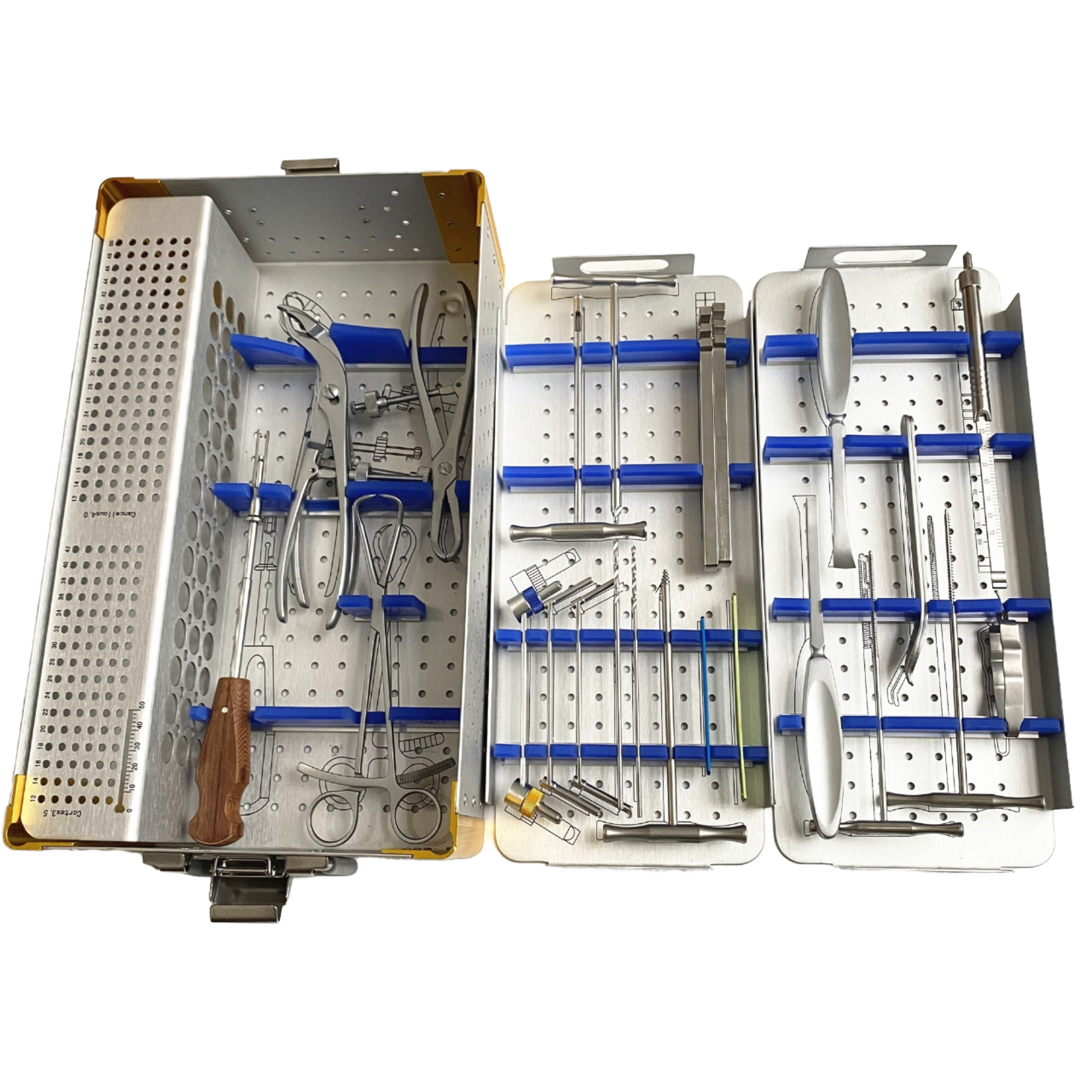
Complete matched surgical instruments—including insertion handles, carbon-fiber targeting arms, flexible reamers, and extraction bolts.
Frequently Asked Questions by Global Buyers
Clear, definitive answers to regulatory, technical, and commercial inquiries routinely handled by our orthopedic export specialists.
Jiangsu GMV Medical holds ISO 13485:2016 quality management system accreditation and CE certifications for our orthopedic implant families. Our factory production processes and testing capabilities have been assessed on-site by TÜV Rheinland. We supply complete technical dossiers, Certificates of Free Sale (CFS), and mill test certificates required for MOH device registrations in South America, Southeast Asia, Central Asia, and the Middle East.
We offer both medical-grade Titanium Alloy (Ti-6Al-4V ELI conforming to ASTM F136 and ISO 5832-3) and implant-grade High-Nitrogen Stainless Steel (316LVM conforming to ASTM F138 and ISO 5832-1). Every raw material batch is traceable through original certified mill test reports documenting chemical composition, grain structure, and mechanical yield strength.
Improper distal or proximal screw alignment during surgery is a primary cause of extended operating time and fluoroscopic exposure. GMV manufactures both implants and insertion jigs concurrently using matched master CNC coordinate programs. Before dispatch, each assembly is subjected to mechanical jig-locking calibration where verification rods pass through all proximal and distal drill sleeves effortlessly.
Yes. As an authentic custom manufacturer with established OEM/ODM service workflows, we support custom laser etching of your brand logo, reference codes, lot numbers, and GS1 2D DataMatrix barcodes. Furthermore, we design and produce multilingual outer cartons, IFUs (Instructions for Use), and validated cleanroom sterile barrier blister packaging per ISO 11607.
For standard catalog sizes of interlocking tibial, femoral, and PFNA nails kept in buffer stock, MOQ can be as low as 10 to 20 units per size to support initial trial validations. For custom OEM manufacturing runs or bespoke instrumentation sets, typical MOQs start at 50 to 100 units. Standard production lead times range between 25 and 45 calendar days depending on specification complexity.
We actively welcome client audits. International hospital procurement officers, tender executives, and third-party notified body auditors frequently visit our facility in Jinfeng Town, Suzhou, Jiangsu Province. If travel schedules are constrained, our engineering department facilitates comprehensive live high-definition video audits traversing incoming inspection, CNC workshops, cleanrooms, and testing laboratories.
