Anatomical Training

Each implant, power tool, and training apparatus is machined under strict ISO-grade mechanical parameters, pairing material resilience with precision clinical geometries.






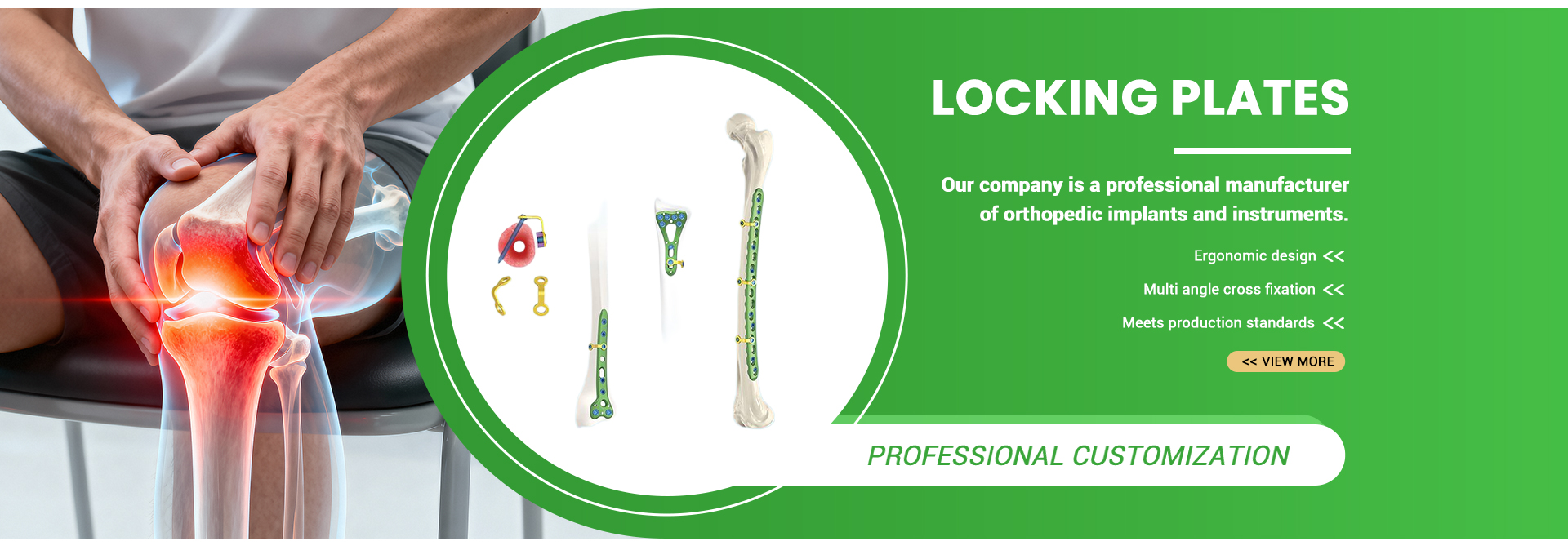
An empirical evaluation of mechanical fatigue thresholds, biological osteointegration surfaces, and supply chain rationalization for hospital networks and international orthopedic distributors.
The global shift from conventional stainless steel to medical-grade titanium alloys like Ti-6Al-4V ELI (ASTM F136) has drastically revolutionized clinical recovery times. By lowering the elastic modulus closer to cortical bone (110 GPa vs 200 GPa of stainless steel), titanium plating systems drastically reduce stress shielding, minimizing secondary bone loss and implant refracture under cyclical axial loading.
Traditional compression plates depended upon periosteal compression to provide stability, often suffocating local blood circulation. Modern Variable-Angle Multi-Axial Locking Plating Systems act as internal fixators, retaining bridging callus vascularization while enabling ±15° screw divergence to purchase comminuted articular fragments without stripping micro-threads.
Implant failure in emergency operating rooms frequently traces back to dimensional mismatching between imported plates and aftermarket screw drivers. Reliable Chinese manufacturers maintain closed-loop CNC tolerances (down to ±5μm), supplying matching instrument kits and sterilizable graphic caddies that eliminate intraoperative cross-threading.
Key decision benchmarks for distributor tenders, public hospital procurement boards, and orthopedic department heads.
| Evaluation Parameter | Ti-6Al-4V ELI (Grade 23 Titanium) | Implant-Grade 316L Stainless Steel | Clinical & Commercial Significance |
|---|---|---|---|
| Elastic Modulus (Stiffness) | ~105 – 115 GPa (Closer to human bone) | ~190 – 210 GPa (Significantly stiffer) | Titanium reduces stress-shielding, accelerating physiological callus bridging and bone remodelling. |
| Diagnostic Imaging Profile | Paramagnetic; minimal CT / MRI scatter | Ferromagnetic artifacts; obscured bone margins | Critical for post-operative non-union evaluations and spine/articular neurological monitoring. |
| Intraoperative Plastic Contouring | Requires precise contouring tools; spring-back | High malleability, ductile under plate benders | Stainless steel allows rapid in-situ anatomic twisting; titanium requires pre-contoured 3D geometries. |
| Corrosion Resistance & Biocompatibility | Spontaneous TiO2 inert passivated layer | Passivated chromium oxide; risk of pitting | Lower systemic ion release with titanium; preferred for long-term or permanent internal osteosynthesis. |
| Cost & Tender Economics | Higher raw material and multi-axis CNC cost | Economical, high volume, cost-effective | Stainless steel dominates price-sensitive national tenders; titanium leads premium hospital brands. |
Anticipate regulatory tightening, supply chain localization shifts, and additive manufacturing adoption to ensure sustained competitive advantage.
Future trauma plates are integrating Electron Beam Melting (EBM) 3D printed porous titanium interfaces with 60–70% interconnecting porosity (300–500μm pores), prompting cellular vascularization and biological osseointegration within comminuted bone gaps without bone grafts.
Global hospital networks are ditching hospital-side autoclaving of multi-tier trays in favor of individually labeled, gamma-irradiated or EtO sterile-packed single-use pre-assembled trauma packs. This slashes nosocomial surgical site infections (SSI) and eliminates hospital processing overheads.
Tighter regulations from the US FDA, EU MDR 2017/745, and NMPA demand granular Unique Device Identification (UDI) etched via deep non-corrosive picosecond laser marking. Full traceability from bar-stock heat lot numbers to patient implantation records is now an absolute prerequisite for market entry.
Operating from our precision facility in Jinfeng Town, Suzhou, we integrate over 27 years of medical manufacturing with verified third-party technical assessments.
Our production floor, quality assurance testing rooms, cleanroom packaging areas, and export processes are audited directly on-site by TÜV Rheinland, providing authentic assessment reports rather than unverifiable claims.
Equipped with multi-axis CNC lathe centers, specialized bone plate milling units, automated electrochemical deburring, and high-speed laser marking systems, we guarantee consistent dimensional accuracy within micron thresholds.
We empower regional medical distributors to build equity in their own brands. From custom CAD/CAM plate geometries to laser marking corporate insignias and designing customized multilingual carton packaging.
Our dedicated physical and chemical testing laboratory runs tensile yield tests, micro-hardness evaluations (Vickers/Rockwell), optical profile projector checks, and bending fatigue validations batch-by-batch.
Unlike specialized single-product shops, GMV medical manufactures locking plates, cannulated screws, interlocking intramedullary nails, spinal fixators, external ring frames, and powered surgical saws under one cohesive warranty umbrella.
With 20 years of continuous global export history, our regulatory affairs specialists provide comprehensive technical dossiers, Certificates of Free Sale (CFS), and ISO-compliant documentation tailored for rapid local MoH approvals.
Critical technical, regulatory, and logistical inquiries addressed to streamline supplier audits and purchase contract authorizations.
Partner directly with a certified, verified Chinese trauma manufacturing leader. Gain immediate access to complete product technical dossiers, CAD geometries, and distributor factory pricing.
