Orthopedic Instruments External Fixator Ringent Rod Coupling
High-strength titanium and stainless steel modular clamping connectors designed for stable rod-to-pin coupling and rapid trauma stabilization.
Constructed from high-purity medical titanium alloy (Ti-6Al-4V ELI) and surgical stainless steel, engineered to deliver exceptional biomechanical fixation, dimensional consistency, and seamless instrument matching.
High-strength titanium and stainless steel modular clamping connectors designed for stable rod-to-pin coupling and rapid trauma stabilization.
Complete autoclavable manual tray containing specialized depth gauges, torque limiters, tap sleeves, and precision drill guides.
High-fidelity anatomical demonstration model utilized by medical schools, orthopedic surgical workshops, and clinical implant training suites.
Stainless steel high-RPM surgical drill and repair handpiece providing high torque, low thermal generation, and smooth micro-reconstruction.
Medical PVC cast model with accurate suture lines, cranial nerve exits, and bone topography for biomechanical and cranio-cervical demonstration.
Heavy-duty autoclavable electric oscillating saw engineered for spine decompression, laminectomy access, and osteotomy procedures.
Anodized aluminum and medical-grade stainless steel storage cassette designed for repeated high-temperature autoclaving and surgical sterile supply.
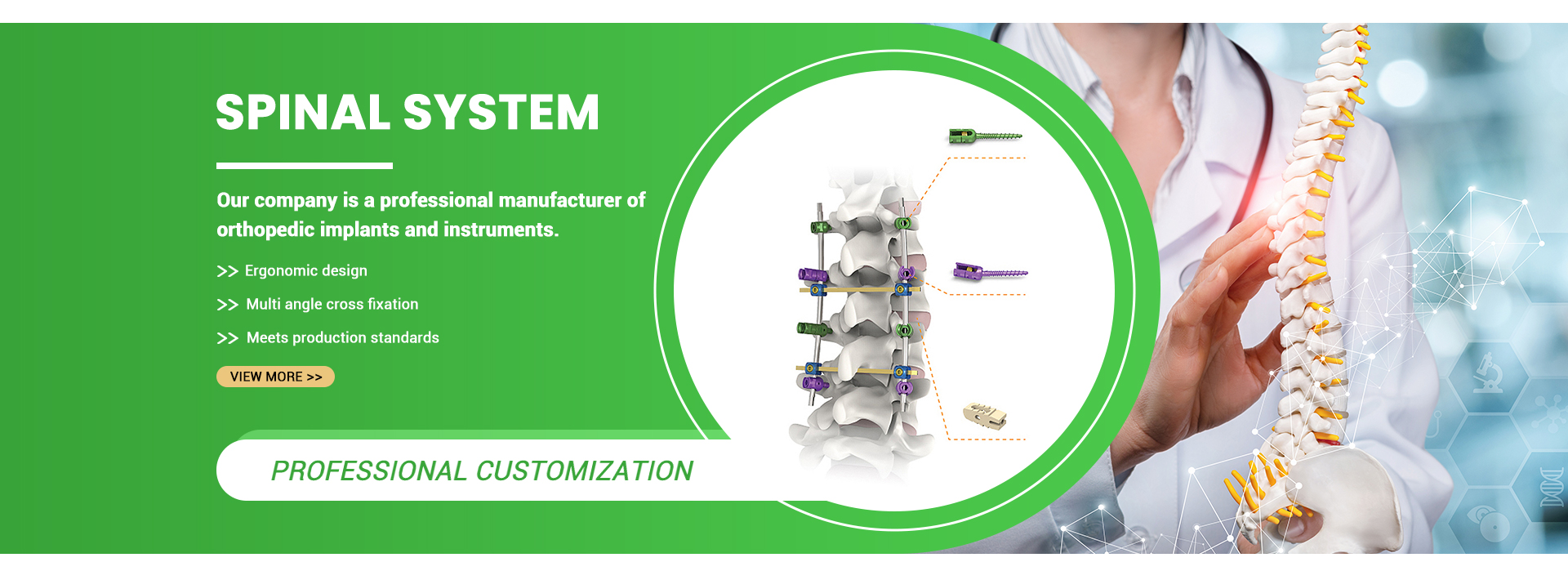
Mono-axial, poly-axial, and cannulated MIS pedicle screws machined with dual-lead thread geometry for rapid purchase and maximum pullout strength.
A clinical and metallurgical evaluation of thoracolumbar and cervical internal fixation architectures for hospital procurement directors, orthopedic tender contractors, and private OEM label distributors.
Spinal fixation systems represent one of the most mechanically demanding segments of implantable medical devices. The human vertebral column functions under complex dynamic loading scenarios, combining axial compression, lateral bending, flexion-extension, and axial rotation. Implantation of posterior pedicle screw constructs, anterior interbody cages, and transverse connectors demands strict compliance with load-sharing principles originally formulated under Denis's Three-Column Spine Theory. When a spinal fusion construct is placed, it must provide immediate, absolute rigid stabilization to neutralize motion across the treated vertebral motion segment (VMS), allowing interbody bone graft consolidation while preventing hardware fatigue failure, screw loosening, or rod breakage.
Over-stiff posterior spinal constructs can provoke stress shielding, where the metal rods bear nearly 100% of the axial load, depriving the intervertebral bone graft of essential mechanical stimulation dictated by Wolff's Law. High-tier Chinese manufacturers now formulate optimized pedicle screw geometries—such as tapered core diameters and differential thread pitch—balancing load transfer between implant hardware and anterior bone graft columns to accelerate osteointegration.
From an engineering perspective, modern Chinese spine fixation exporters must maintain stringent metallurgical consistency. Implants fabricated from Ti-6Al-4V ELI (Extra Low Interstitial, ASTM F136 / ISO 5832-3) offer substantial advantages over legacy 316LVM stainless steel. Titanium’s modulus of elasticity (~114 GPa) is roughly half that of stainless steel (~200 GPa), drastically reducing stress shielding at the bone-screw interface while delivering superior fatigue life (evaluated up to 5 million cycles under ASTM F1717 axial fatigue protocols). Furthermore, titanium constructs provide significantly improved post-operative artifact performance in Magnetic Resonance Imaging (MRI) and Computed Tomography (CT) scans, allowing spine surgeons to evaluate neural decompression and fusion healing without massive diagnostic distortion.
| Biomechanical & Material Parameter | Ti-6Al-4V ELI (ASTM F136) | Medical PEEK-OPTIMA (ASTM F2026) | 316LVM Stainless Steel (ASTM F138) |
|---|---|---|---|
| Modulus of Elasticity (GPa) | 110 – 114 GPa (Moderate) | 3.5 – 4.0 GPa (Close to Cancellous Bone) | 195 – 210 GPa (High Stiffness) |
| Ultimate Tensile Strength (MPa) | ≥ 860 MPa | 95 – 105 MPa | ≥ 800 MPa |
| Biocompatibility & Osseointegration | Direct bone on-growth via oxide layer | Hydrophobic (Requires Ti/HA coating) | Passive chrome oxide layer (Long-term ion release) |
| Radiographic Imaging Artifacts | Low-to-medium MRI artifact | Completely radiolucent (Tantalum markers) | Severe CT/MRI scatter and blinding |
| Primary Clinical Applications | Pedicle screws, occipital plates, rods | Interbody cages (PLIF, TLIF, ALIF) | Economical trauma plates, traction pins |
In the domain of interbody spinal fusion (cages), polyetheretherketone (PEEK-OPTIMA conforming to ASTM F2026) has historically dominated due to its radiolucency and low modulus of elasticity (~3.6 GPa), which closely mimics natural trabecular bone. However, PEEK’s intrinsic biological inertness frequently yields a fibrous capsule rather than true osseous integration. Leading Chinese exporters have countered this limitation by introducing advanced 3D printed additive manufactured porous titanium cages and plasma-sprayed titanium-coated PEEK implants. These micro-porous architectures possess interconnected pore structures (300–600 μm) and over 60% porosity, replicating human cancellous bone topography to foster capillary ingrowth and rapid bony bridging.
Manufacturing excellence for pedicle screw systems centers on micro-machining tolerances. The pedicle screw's tulip saddle and inner thread profile must exhibit precise pitch tolerances to prevent "cross-threading" when the locking set screw is introduced intraoperatively under high surgical pressure. High-end multi-axis CNC Swiss-type lathes utilize synchronized live-tooling to cut buttress or square-thread locking mechanisms that generate direct downward clamping force without outward tulip splay. If a factory's CNC tolerance control drifts beyond ±0.008 mm, the tulip head risks splaying under torque thresholds (>10-12 Nm), inducing premature rod slippage and hardware destabilization.
Strategic dynamics transforming international distribution, tender qualification, and hospital procurement channels over the coming five years.
China's centralized healthcare reforms have compressed domestic pricing, forcing Tier-1 manufacturers to direct advanced CNC production capacity toward international markets. Global buyers can now procure premium-grade spine systems at factory-direct pricing with identical metallurgical and dimensional certifications.
Hospitals worldwide are pushing back against the operational costs and infection vectors associated with reprocessing multiple multi-tier instrument loaner trays. Procurement departments are demanding factory-pre-sterilized, double-blistered implant packs paired with single-use, recyclable delivery tools.
Minimally Invasive Spine (MIS) procedures require cannulated pedicle screws, extended-tab break-off tulips, and radiolucent carbon-fiber retractors. Procurement specifications now mandate compatibility with intraoperative robotic guidance and optical stereotactic navigation arrays.
Regulatory hurdles in Europe and Latin America require spine exporters to furnish exhaustive clinical evaluations, ISO 13485:2016 audited files, and laser-etched Unique Device Identification (UDI) directly on implants to guarantee life-cycle post-market surveillance.
Standard smooth PEEK cages are losing market share to 3D electron-beam-melted (EBM) titanium lattices. Procurement managers are favoring manufacturers with on-site additive printing clusters capable of rapid custom geometries and porous trabecular surfaces.
To eliminate surgical friction, procurement officers require integrated single-source deliveries: pedicle screws, pre-cut rods, crosslinks, reduction towers, and sterilization containers delivered under one unified warranty and inspection protocol.
From cortical bone trajectory fixation to bioactive surface modifications, spine engineering is evolving from passive hardware to biologically active fixation.
The clinical landscape of spine surgery is experiencing a paradigm shift driven by demographic aging and the rising incidence of severe osteoporosis. Traditional pedicle screw fixation relies heavily on cancellous bone density within the vertebral body. In osteoporotic bone, traditional pedicle screws are prone to micro-motion, toggling, and pull-out under physiologic flexion moments. In response, Chinese engineering teams have developed two critical innovations: Cortical Bone Trajectory (CBT) screws and Fenestrated Cannulated Cement-Augmented screws.
CBT screws utilize a specialized medial-to-lateral, caudo-cephalad trajectory through the pedicle. This screw path engages four distinct cortical bone zones (the posterior lamina, the medial pedicle wall, the superior pedicle cortex, and the anterolateral vertebral wall). Because the screw's thread profile features a narrower pitch and deeper thread design, it provides an increase of over 30% in insertional torque and up to 1.7 times greater pullout force compared to traditional trajectory screws in low-density bone. For advanced degenerations, fenestrated pedicle screws incorporate radial perfusion ports along their distal third, allowing controlled injection of polymethylmethacrylate (PMMA) bone cement directly into the surrounding trabeculae to anchor the screw construct firmly.
Electrochemical surface passivation thickens the natural titanium dioxide layer, eliminating micro-fretting corrosion at rod-screw junctions and significantly diminishing metal ion leaching into adjacent paraspinous tissues.
Spherical screw head engineering allows conical angulation arcs up to 60°, reducing the necessity for severe intraoperative rod contouring and mitigating localized stress concentrations in the metal rod.
Sub-micron hydroxyapatite (HA) plasma spraying combined with acid-etched microroughness stimulates direct osteoblast adhesion, converting the implant interface into a bioactive osteoconductive substrate.
Jiangsu GMV Medical Device Co., Ltd. is located in Jinfeng Town, Suzhou, China—an international hub for high-precision orthopedic manufacturing. Operating for over 27 years with an on-site verified workforce of 121 skilled technicians and engineers, we eliminate middlemen markups to provide direct tier-one manufacturing value to global healthcare distributors.
Our comprehensive production ecosystem spans raw titanium bar verification, high-speed multi-axis CNC milling, automatic thread rolling, vibratory finishing, cleanroom washing, cleanroom packing, and laser-marking traceability.
Clear, technical, and regulatory answers addressing supplier qualification, material sourcing, mechanical durability, and custom OEM processes.
Our spinal pedicle screws, fixation rods, transverse crosslinks, and anterior plates are manufactured exclusively from certified implant-grade Titanium Alloy (Ti-6Al-4V ELI conforming to ASTM F136 and ISO 5832-3). For interbody fusion devices (cages), we employ virgin Medical PEEK-OPTIMA conforming to ASTM F2026 or 3D-printed additive porous medical titanium (Grade 5 or Grade 23). Every incoming batch of bar stock is accompanied by verified mill test reports (MTR) validating chemical composition, gas content (oxygen, nitrogen, hydrogen), microstructure, and tensile strength before entering CNC processing.
Our thoracolumbar pedicle screw and rod constructs undergo extensive mechanical validation based on ASTM F1717 (Standard Test Methods for Spinal Implant Constructs in a Vertebrectomy Model). This includes static compression bending, static torsion, and dynamic compression fatigue testing up to 5,000,000 cycles at a frequency of 5 Hz in saline environments. Our optimized tulip-to-shank junction and rounded thread root radius prevent localized stress concentration, consistently exceeding standard fatigue runout load limits (averaging over 220 N to 260 N dynamic load threshold), ensuring construct integrity during prolonged non-union healing periods.
Yes, we actively welcome hospital procurement delegations, tender committees, and private label distributors to audit our physical production plant in Jinfeng Town, Suzhou, Jiangsu Province. Our site has been comprehensively assessed and verified on-site by TÜV Rheinland. For clients unable to travel immediately, we facilitate full-scope live video audits, walking your technical inspectors through raw material warehousing, CNC production lines, cleanroom washing areas, optical inspection laboratories, and finished goods logistics.
We provide full-lifecycle OEM/ODM production. You can provide customized 2D/3D engineering drawings (CAD/STEP) or physical surgical samples. Our R&D engineering department handles DFM (Design for Manufacturability) analysis, tooling optimization, and prototype creation within 15–20 working days. We support permanent high-resolution fiber-laser etching (brand logos, reference codes, lot numbers, and GS1-compliant 2D DataMatrix UDI barcodes), customized multi-color anodization (gold, magenta, royal blue, aqua), customized graphic sterilization cases, and bespoke export packaging.
One of the primary causes of surgical complications is dimensional mismatch between pedicle screw drive sockets and surgical screwdrivers. As a vertically integrated manufacturer, GMV Medical produces both implants and their dedicated surgical instrumentation sets under the same roof. Screwdriver tips (T20, T25, or hexalobe) and screw recess geometries are machined on synchronized CNC centers using matching gauge tolerances. Every batch is physically dry-fit tested to ensure optimal torque transmission, zero wobbling, and secure retention during intraoperative placement.
We assist our global export partners with comprehensive regulatory dossier compilations tailored to target market authorities (e.g., FDA 510(k), CE MDR technical files, COFEPRIS, ANVISA, SFDA). Standard documentation packages include ISO 13485:2016 Quality Management System certificates, Certificates of Free Sale (CFS), Declarations of Conformity (DoC), Mill Test Certificates for raw materials, biocompatibility reports (ISO 10993 series), sterilization validation files (ISO 11137 / ISO 11135), and ASTM F1717 mechanical test reports.
Whether participating in national hospital tenders, expanding your orthopedic distribution catalog, or launching a proprietary private label spine line, our engineering and export team in Suzhou, China is prepared to deliver precision manufacturing and full technical support.