Featured Orthopedic & Spinal Surgical Product Systems
Explore our specialized surgical instrumentation kits, powered bone excision tools, anatomical guidance models, and certified internal fixation implants engineered for seamless operating theatre workflows.

Lab Teaching Models 3 Parts Human Muscular Skull Skeleton
Anatomically accurate cranial and cervical demonstration model for pre-operative planning and clinical instruction.

Small Fragment Orthopedic Upper Limb Instrument Kit
Medical-grade stainless steel instrumentation kit tailored for bone plate reduction, depth gauging, and trauma screw placement.

Electric Surgical Implant Tool Box Steel Construction
Autoclavable, high-grade stainless steel sterilization storage cassette designed for micro-motor power instruments.

Metal Sternum Saw CE Certified Medical Electric Saw
Ergonomic motorized oscillating sternum and bone saw system engineered for high-torque arthroplasty and thoracic incisions.

High-Speed Surgical Repair Handpiece Power Source
Micro-precision rotary handpiece with integrated irrigation channels, optimized for spinal osteotomy and high-speed burring.

Lab Teaching Models Separated Human Skull PVC Model
Modular craniofacial study cast with distinct cranial bones, ideal for biomechanical instrumentation orientation.

External Fixator Ringent Rod Coupling Orthopedic Clamp
High-rigidity coupling unit for circular or unilateral frame assembly, offering rapid pin-to-rod multi-angle articulation.
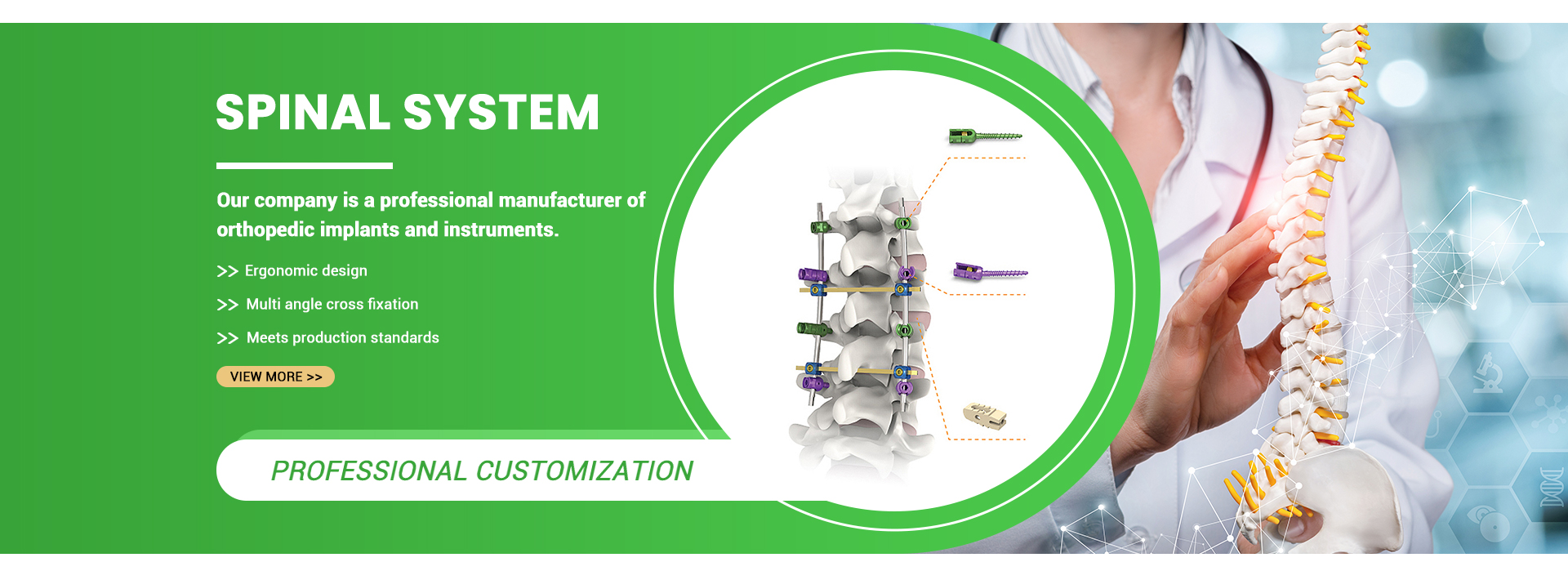
TLIF / PLIF / ALIF Spinal Fusion Cage & Fixation System
TÜV-verified polyaxial pedicle screws, cross-links, and anatomical PEEK / 3D porous titanium spinal cages for arthrodesis.
27+ Years
Industry Manufacturing History121 Staff
Skilled Technicians & MachinistsTÜV Verified
On-Site Factory Audit Audited16+ Languages
Direct Global Export DeskEngineering Spinal Fusion Cages: Biomaterial Selection & Osseointegration Dynamics
In modern spinal arthrodesis, interbody fusion cages are tasked with restoring anterior column disc height, maintaining sagittal lordosis, decompressing neural foramina, and establishing an osteoconductive environment for rapid arthrodesis.
Polyetheretherketone (PEEK-OPTIMA)
Medical-grade PEEK remains an industry cornerstone due to an elastic modulus (~3.6 GPa) closely matching human trabecular and cortical bone, thereby drastically minimizing stress-shielding and adjacent segment degeneration.
- 100% radiolucent for radiographic fusion assessment
- Tantalum or Ti alloy markers for clear X-ray / CT localization
- High fatigue endurance under cyclic axial loads
- Zero toxic element release under physiological conditions
3D Porous Trabecular Titanium (Ti-6Al-4V ELI)
Manufactured using selective laser melting (SLM) and electron beam melting (EBM), porous titanium simulates the macro-, micro-, and nano-architecture of natural cancellous bone to drive spontaneous osseointegration.
- Fully interconnected 600–800 μm pore geometry
- 65% to 80% porosity accelerating bone ingrowth
- Wetted capillary action promoting autograft blood absorption
- Direct cellular anchor without delimitation risk
Surface Modified & Expandable Mechanisms
Addressing the limitations of smooth PEEK, titanium plasma spray (TPS) coatings and in-situ mechanical expandability provide low insertion profiles while restoring aggressive disc height and lordotic alignment.
- Low initial profile preserves vertebral endplate integrity
- Continuous mechanical expansion up to 15° lordosis
- Internal bone graft delivery post-expansion
- Micro-textured anti-migration retentive teeth
| Implant Parameter | Medical Grade PEEK | 3D Additive Porous Titanium | Titanium Plasma-Sprayed PEEK |
|---|---|---|---|
| Elastic Modulus (GPa) | 3.5 – 4.0 GPa (Close to cortical bone) | 2.0 – 5.0 GPa (Engineered scaffold) | 3.6 GPa core / 110 GPa coating |
| Primary Osseointegration | Fibrous tissue encapsulation without coating | Rapid osteoblast adhesion & bone ingrowth | Direct biological ongrowth to Ti layer |
| Post-Op Radiographic Assessment | Excellent (Artifact-Free) | Minor halo artifacts on CT/MRI | Artifact-free lumen with visible coating line |
| Subsidence Risk (ASTM F2267) | Low (Elastic strain buffer) | Ultra-Low (Expanded contact footprint) | Low (Friction lock prevents micromotion) |
| Manufacturing Protocol | High-Precision 5-Axis CNC Milling | Additive DMLS / EBM Laser Sintering | CNC Precision Milling + Vacuum Plasma Spray |
| Sterilization Compatibility | Autoclave, Gamma, EtO | Autoclave, Gamma, EtO | Gamma Irradiation, EtO Preferred |
Future Procurement Trends in the Global Spinal Implant Market
Global orthopedic supply chain managers, hospital network tender boards, and medical device brand holders face evolving economic, regulatory, and technological pressures. Understanding these macro shifts is vital to sustainable margin defense.
1. Tier-1 Consolidation to Direct OEM Contracting
Rising procedural costs have compelled healthcare authorities (e.g., NHS tenders, US ASC purchasing groups, Latin American social security programs) to bypass Western label-packagers and establish contract-manufacturing alliances directly with verified Asian factories.
- Elimination of 40–60% distributor markup margins
- Customized surgical instrumentation set branding
- Rapid batch turnarounds for customized tender profiles
2. Harmonized Regulatory Verification (MDR & 510(k))
Global supply chains no longer tolerate uncertified manufacturing. Exporters must demonstrate compliance with ISO 13485:2016 and complete Class III technical files covering biocompatibility (ISO 10993) and comprehensive mechanical test validation.
- Mandatory ASTM F2077 static & dynamic testing data
- ASTM F2267 subsidence testing verification
- Full traceability from raw ingots to packaged lots
3. Surgical Instrument-to-Implant Integration
Procuring raw cages in isolation leads to high intra-operative complications. Hospital boards demand unified, turnkey implant-instrument configurations where cage inserters, trial rasps, and vertebral distractors match cage tolerances precisely.
- Single-point accountability for fit and torque
- Custom sterilization trays with custom laser engraving
- Long-lasting surgical instruments fabricated from 17-4PH steel
Technological & Clinical Development Trends in Spine Arthrodesis
The interbody cage industry is transitioning from passive spacing devices into osteoinductive, patient-matched biomechanical solutions. Manufacturers investing in digital engineering lead the next market evolution.
1. Patient-Specific Custom Additive Cages
Utilizing high-resolution preoperative DICOM CT datasets, OEM suppliers now generate anatomically matching patient-specific cages (PSCs) for severe deformity reconstructions, tumor resection, and revision arthrodesis.
- Exact endplate mapping to distribute contact stress
- Correction of multi-planar scoliosis and kyphosis
- Elimination of intraoperative endplate over-rasping
2. Nanotechnology & Bioactive Coatings
Moving beyond inert biomaterials, cages are engineered at the nanoscale with hydrophilic surfaces, hydroxyapatite (HA) nano-crystals, and silicon nitride coatings designed to actively modulate local mesenchymal stem cell expression.
- Upregulation of alkaline phosphatase and osteocalcin
- Inhibition of bacterial colonization and biofilm generation
- Accelerated bridging trabecular bone within 6–12 weeks
3. MIS & Navigation-Ready Footprints
Minimally Invasive Surgery (MIS) corridors—such as Oblique Lumbar Interbody Fusion (OLIF), Direct Lateral Interbody Fusion (DLIF), and endoscopic transforaminal approaches—require cages compatible with computer-navigated arrays.
- Self-distracting nose cones for atraumatic insertion
- Integrated tracker arrays for robotic guidance alignment
- Optimized graft chamber volumes for synthetic bone putty
Manufacturing Excellence: Jiangsu GMV Medical Device Co., Ltd.
Headquartered in Jinfeng Town, Zhangjiagang (Suzhou), Jiangsu, China, Jiangsu GMV Medical Device Co., Ltd. represents over 27 years of dedicated orthopedic manufacturing. Unlike trading intermediaries, we operate complete in-house CNC machining, surface finishing, and class-leading inspection facilities.
TÜV Rheinland On-Site Assessed
Our production facilities, cleanroom packaging standards, and QA/QC management protocols undergo periodic third-party auditing by TÜV Rheinland for total buyer confidence.
Swiss Multi-Axis CNC Precision
Utilizing premium Citizen and DMG Mori multi-axis turning-milling centers, we execute complex PEEK serrations, micro-threads, and titanium tolerances within ±0.005mm.
In-House Mechanical Testing Lab
Equipped with computerized tensile testers, optical profile projectors, and Rockwell hardness testers, ensuring each raw batch matches certified Ti-6Al-4V ELI / ASTM F2026 PEEK specs.
Turnkey OEM/ODM Engineering
From CAD step files or clinical design sketches to custom master molds, DFM engineering feedback, private laser branding, and customized blister/carton packaging.
Global Export Desk (16+ Languages)
Our multilingual export documentation specialists manage shipping clearance, consular legalization, Certificates of Free Sale (CFS), and regulatory registration files worldwide.
Comprehensive Implant Portfolio
Beyond spinal cages, GMV supplies matching pedicle screws, occipito-cervical systems, anatomical trauma locking plates, intramedullary nails, external fixators, and power surgical tools.
Frequently Asked Questions by Global Spine Implant Importers
Answers to critical questions surrounding compliance, testing standards, OEM private labeling, and procurement procedures.
What specific international mechanical testing standards do your spinal fusion cages meet?
Our spinal interbody fusion cages undergo rigorous destructive and non-destructive evaluations in strict accordance with ASTM F2077 (Test Methods for Intervertebral Body Fusion Devices, evaluating static compression, dynamic axial fatigue up to 5,000,000 cycles, static shear, and dynamic torsion) and ASTM F2267 (Standard Test Method for Measuring Load Induced Subsidence Under Static Axial Compression). Full test reports are made available to partner distributors for national health authority clearance submissions.
Can Jiangsu GMV Medical manufacture custom cage geometries based on our proprietary CAD drawings?
Yes. As a direct OEM/ODM custom manufacturer, our engineering department converts client 3D STEP, IGES, or SolidWorks files into machine code via Mastercam. We perform comprehensive Design for Manufacturability (DFM) reviews, suggest optimal toolpaths, build custom jigs, and produce first-article inspection (FAI) prototypes alongside full CMM dimension validation sheets prior to mass production.
What raw materials are sourced for your PEEK and titanium spinal cage series?
We source exclusively implantable-grade raw materials accompanied by comprehensive material certs. For polymeric implants, we utilize virgin implant-grade PEEK polymer (compliant with ASTM F2026). For metallic cages and radiopaque markers, we utilize certified Medical Grade Titanium Alloy Ti-6Al-4V ELI (Extra Low Interstitial, compliant with ASTM F136 / ISO 5832-3). Full chemical composition and tensile mill test certificates are traced to each manufactured lot number.
How does GMV ensure cleanroom sterility or ready-to-sterilize cleanliness for export shipments?
All finished implants undergo multi-stage ultrasonic degreasing and purified deionized water baths to remove microscopic particulate and hydrocarbon residues. Products can be delivered in non-sterile bulk configurations protected in surgical-grade Tyvek blister packs, or packaged inside cleanrooms (ISO Class 7/Class 8) compatible with Gamma radiation or Ethylene Oxide (EtO) terminal sterilization regimens.
Can international procurement teams and distributors conduct physical or live video factory audits?
Yes, we actively welcome hospital purchasing executives, distributor QA directors, and qualification committees to visit our primary manufacturing complex in Jinfeng Town, Suzhou, Jiangsu Province, China. For remote verification, we regularly host live high-definition video audits encompassing our CNC machine bays, QC measurement lab, optical inspection stations, cleanroom packaging areas, and finished goods warehouse.
What are the typical Lead Times and Minimum Order Quantities (MOQ) for custom OEM projects?
For standard catalog configurations (TLIF, PLIF, ALIF, Cervical cages in standard heights and lordotic angles), MOQ begins as low as 50 to 100 units with delivery within 2–4 weeks. For custom OEM/ODM tooling programs requiring custom laser marking and dedicated packaging, tooling and FAI approval generally takes 4–6 weeks, followed by full batch production dispatched within 30–45 business days.
Initiate Your Custom Spinal Fusion Cage OEM Project
Connect directly with our senior orthopedic engineering and export team. Receive immediate DFM analysis, comprehensive ASTM technical files, mill certificates, and a confidential OEM price proposal tailored to your regional market requirements.
