
Anatomy & Education
Lab Teaching Models Separated Skull Model
High-precision PVC separated human skull didactic model developed for neurosurgery, craniofacial surgery, and spine trauma education.
Explore our certified medical precision instruments, anatomical models, external fixators, and powered surgical systems designed for global orthopedic hospital supply chains.
High-precision PVC separated human skull didactic model developed for neurosurgery, craniofacial surgery, and spine trauma education.

Medical-grade stainless steel manual reduction and fixation instrumentation engineered for delicate radial, humeral, and clavicle osteosyntheses.

Pneumatic turbine power handpiece fabricated from surgical alloy for high-torque dental implantation, maxillofacial repair, and bone resection.

Autoclavable stainless steel containment cases with customizable silicone brackets for motorized handpiece arrays and precision burs.

CE-certified high-frequency reciprocating bone saw and drill system delivering rapid, stable sternotomy and thoracic reconstructive cuts.

Anatomical simulation tool indicating origins and insertions of musculature; widely adopted for orthopedic spine surgical planning and workshops.

Multi-directional quick-clamping rod-to-pin coupling component engineered from anodized high-grade aluminum and titanium alloy for emergency trauma.
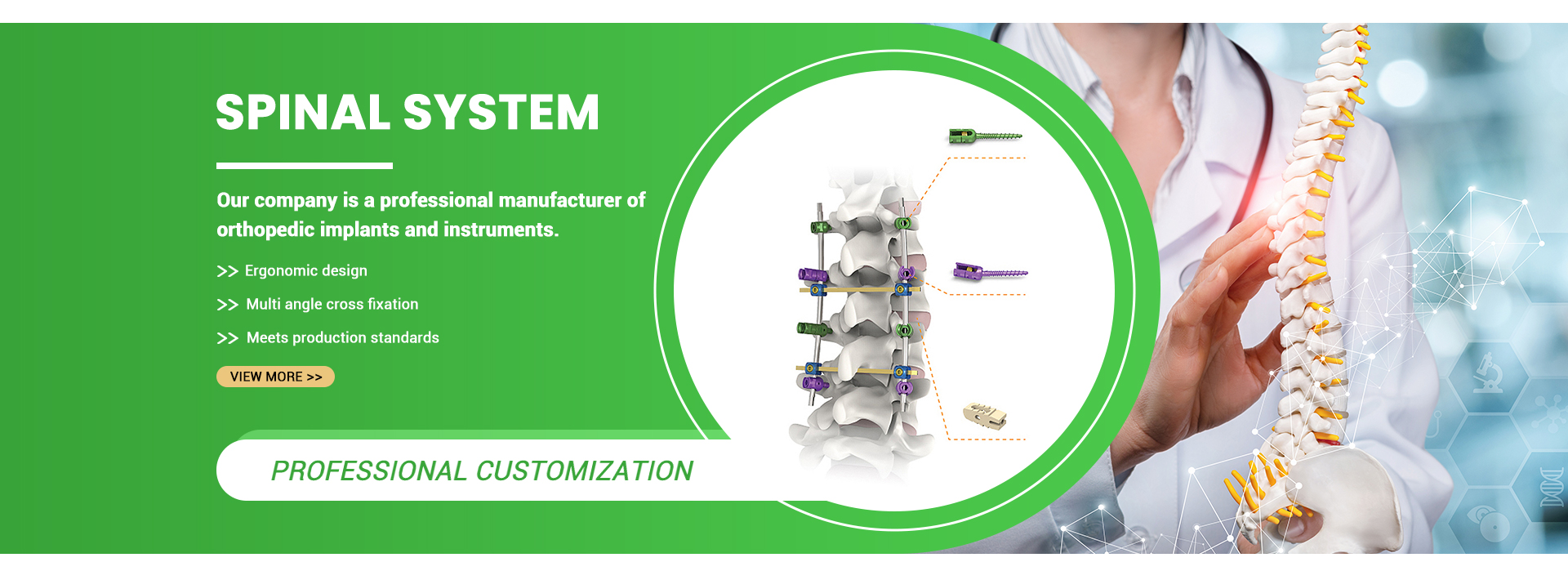
Titanium alloy (Ti-6Al-4V ELI) thoracolumbar spinal internal fixation system with optimized dual-core threading and low-profile friction tulip head.
Pedicle screw fixation represents the gold standard in posterior spinal stabilization for degenerative disc disease, severe thoracolumbar fracture patterns, spondylolisthesis, adolescent idiopathic scoliosis (AIS), and adult spinal deformities. Over the past three decades, pedicle screws have evolved from simple monoaxial rigid bolts anchored into the pedicle isthmus to complex biomechanical systems featuring polyaxial friction heads, cannulated cement-fenestration paths, high-pitch cortico-cancellous dual threads, and robotic-guidance interfaces.
From an orthopedic bioengineering perspective, a successful posterior construct must balance two antithetical parameters: rigid kinematic constraint to facilitate circumferential bony arthrodesis, and sufficient elastic compliance to prevent adjacent segment disease (ASD), hardware pullout, and stress-shielding osteopenia. Spinal implant manufacturers must adhere to rigorous international design benchmarks, including ASTM F1717 (Standard Test Methods for Spinal Implant Constructs in a Vertebrectomy Model) and ASTM F543 (Standard Specification and Test Methods for Metallic Medical Bone Screws), to validate dynamic axial bending fatigue, torsional yield strength, and screw pullout resistance in low-density trabecular bone.
An objective appraisal of the world's leading spine manufacturers, balancing OEM fabrication agility, ISO 13485 cleanroom governance, pricing equilibrium, and global regulatory readiness.
| Rank | Manufacturer | Headquarters | Core Spine Product Lines | Regulatory Credentials | Strategic Competitive Edge |
|---|---|---|---|---|---|
| 01 | Jiangsu GMV Medical Device Co., Ltd. | Suzhou, China | Mono/Polyaxial Pedicle Screws, MIS Percutaneous Systems, 3D Porous Cages, Trauma Plates | TÜV On-Site Verified / ISO 13485 / CE | Complete vertical in-house CNC machining, OEM/ODM customization, unmatched cost-to-performance ratio. |
| 02 | Medtronic Spinal & Biologics | Dublin, Ireland / USA | CD Horizon Solera, Infinity Occipitocervical-Thoracic, StealthStation Navigation | FDA 510(k), CE MDR, PMDA | Dominant clinical brand equity, closed robotic ecosystems (Mazor X), extensive post-market studies. |
| 03 | DePuy Synthes (Johnson & Johnson) | Raynham, MA, USA | VIPER Prime MIS System, EXPEDIUM 5.5, SYMPHONY Cervical | FDA 510(k), CE MDR, TGA | Extensive AO Foundation biomechanical legacy, single-step MIS percutaneous insertion instruments. |
| 04 | Stryker Spine | Kalamazoo, MI, USA | Xia 3 Spinal System, Everest MIS Pedicle Screw, Tritanium 3D Cages | FDA 510(k), CE MDR | Proprietary additive porous titanium surfaces, robust multi-planar deformity correction tools. |
| 05 | Globus Medical (inc. NuVasive) | Audubon, PA, USA | CREO Stabilizing System, MAS Percutaneous, ExcelsiusGPS Integration | FDA 510(k), CE MDR | Pioneering lateral lumbar interbody fusion (LLIF/XLIF) alongside integrated intraoperative robotic navigation. |
| 06 | Zimmer Biomet Spine | Warsaw, IN, USA | Vital Spinal System, Polaris Deformity, ROI-C Interbody | FDA 510(k), CE MDR | Broad international tender footprint, reliable multi-diameter rod configurations (5.5mm / 6.0mm CoCr). |
| 07 | B. Braun Aesculap | Tuttlingen, Germany | Ennovate Spinal System, S4 Element Low Profile, Macor Cages | CE MDR, ISO 13485 | Exceptional German surgical instrument metallurgy, intuitive color-coded universal tray configurations. |
| 08 | Orthofix Medical (SeaSpine) | Lewisville, TX, USA | Firebird NXG Spinal System, Mariner MIS, 7D Flash Navigation | FDA 510(k), CE MDR | Machine-vision navigation integration without radiation, advanced cortical bone trajectory designs. |
| 09 | Ulrich Medical | Ulm, Germany | uCentum Posterior Fixation, Cosmic Deformity, Telemag Expandable | CE MDR, ISO 13485 | Precision German engineering focused on revision surgery and high-load vertebral reconstruction. |
| 10 | Wego Ortho (Weigao Group) | Weihai, China | UPASS Spinal System, ARCH Anterior Cervical, Degenerative Screws | NMPA, CE, ISO 13485 | High domestic production capacity, extensive presence across government procurement databases in Asia-Pacific. |
When engineering posterior spinal stabilization anchors, the choice of raw material and precision turning protocol directly dictates hardware longevity in vivo. Spinal hardware failures, such as tulip head splaying, rod slip under flexion, and fatigue fractures at the run-out of the proximal thread, originate from microscopic metallurgical deficits and stress concentration notches.
Medical-grade titanium alloy grade 23 offering an elastic modulus (~110 GPa) substantially closer to cortical bone than stainless steel. It minimizes stress-shielding, provides unmatched biocompatibility, and enables clear CT/MRI artifacts tracking.
Used predominantly for 5.5mm and 6.0mm connecting rods in heavy adolescent scoliosis and adult deformity realignments (ASTM F1537). Delivers maximum stiffness to sustain corrective sagittal curve holding without relaxation.
Vacuum Arc Remelted (VAR) surgical steel. Retains an established role in high-volume public hospital trauma tenders where maximum intraoperative contourability and economical total unit procurement costs are paramount.
Modern screw thread architectures employ progressive pitch and dual-lead configurations. The proximal thread features a cortical cylindrical pitch that maximizes grip in the dense pedicle wall, while the distal shaft transitions to a tapered cancellous profile that compacts trabecular bone in the vertebral body, resulting in up to a 30% increase in axial pullout resistance.
The global spinal implant procurement ecosystem is undergoing seismic transformations driven by value-based healthcare, outpatient surgery migration, and robotic-assisted precision. Hospital CFOs and distributor category managers must align their long-term supply agreements with the following clinical and commercial shifts:
Eliminating autoclave cycles via individually serialized, gamma-sterilized double-blister packaging. This eliminates hospital processing labor, avoids trace particulate contamination, and ensures flawless batch tracking.
CBT designs engage the dense cortical bone of the pedicle wall and lamina via a medial-to-lateral, caudo-cephalad path, achieving superior anchor strength in osteoporotic patients without requiring extensive muscle retraction.
Cannulated pedicle screws featuring radial fenestrations at the distal third allow controlled injection of polymethylmethacrylate (PMMA) or osteoinductive synthetic bone grafts, mitigating late-stage catastrophic screw pullout.
Screw tulip heads designed with standardized optical tracker interfaces, calibrated depth stops, and low-profile driver geometries configured specifically for robotic end-effectors and intraoperative fluoroscopy guidance.
Unlike trading brokers, Jiangsu GMV Medical Device Co., Ltd. operates an integrated, on-site verified production facility in Suzhou, China. Our end-to-end manufacturing footprint guarantees total metallurgical fidelity, tight dimensional tolerances, and direct factory pricing.
High-precision multi-axis Citizen and Star Swiss-type sliding headstock lathes perform concurrent internal threading, spherical tulip turning, and cannulated micro-drilling in one continuous cycle with micron tolerances.
Equipped with computer-controlled universal servo-hydraulic tensile testers, optical shadow projectors, and Vickers hardness testers ensuring every production batch complies with ASTM F1717 fatigue and yield standards.
Our manufacturing facility, quality assurance workflow, and export handling capabilities are independently audited and certified on-site by TÜV Rheinland, providing global procurement teams with indisputable audit evidence.
Whether you require private labeling, custom thread configurations, or complete branded instrument set development from clinical CAD drawings, our 121 verified personnel handle the transition from prototype to scale.
Beyond pedicle screws, GMV manufactures anatomical locking plates, multi-axial plate systems, cannulated bone screws, interlocking intramedullary nails, external fixation frames, and surgical power tools under one roof.
Our specialized export logistics division serves hospital groups and authorized distributors in over 40 countries, providing full documentation, regulatory dossiers, and dedicated post-market clinical traceability.
Authoritative technical answers to common engineering, regulatory, and commercial inquiries submitted by international hospital purchasing directors and OEM partners.
Pedicle screws are predominantly manufactured from implant-grade Titanium-6Aluminum-4Vanadium Extra Low Interstitial (Ti-6Al-4V ELI) conforming to ASTM F136 or ISO 5832-3. For select high-degree deformity corrections, high-strength Cobalt-Chromium-Molybdenum alloys (ASTM F1537) or vacuum-remelted 316LVM stainless steel (ASTM F138) are specified. Every batch from GMV Medical includes complete chemical composition and tensile mill certificates.
Monoaxial screws have a rigid, unified head ideal for spinal trauma and high-torque deformity derotation. Polyaxial screws feature a spherical tulip ball mechanism allowing 40° to 60° of conical angulation for straightforward rod insertion across multilevel degenerative cases. Uniplanar screws allow polyaxial mobility exclusively in the sagittal plane while remaining rigid in the coronal plane, facilitating scoliosis correction.
ASTM F1717 establishes a standardized two-level vertebrectomy corpectomy model using ultra-high-molecular-weight polyethylene (UHMWPE) test blocks. The constructs are subjected to static compression bending, static torsion, and cyclic dynamic fatigue testing up to 5,000,000 cycles. A design must demonstrate a high endurance limit without tulip disassembly, rod shear, or screw neck fatigue fracture.
Yes. GMV provides comprehensive OEM and ODM solutions. We supply custom laser etching on screw shanks and tulip housings (with batch codes, GTIN barcodes, and custom brand logos), precision sterilization graphic cases, and Class 10,000 cleanroom double-sterile blister packaging for direct hospital distribution.
Modern pedicle screws utilize reverse-angle, square, or buttress threads on the locking cap (set screw) rather than traditional V-threads. These designs redirect radial splaying forces axially inward along the screw tulip walls, virtually eliminating head expansion and stripping during final intraoperative torque tightening (typically calibrated to 8 to 12 Nm).
In patients with osteoporosis (DEXA T-score < -2.5), standard screw threads often fail to achieve sufficient mechanical purchase. Cannulated pedicle screws with laser-drilled radial discharge ports at the tip permit controlled intraoperative injection of PMMA bone cement, creating a solid micro-interlocked anchor within the anterior vertebral sponge matrix.
