Featured Clinical Systems & Surgical Power Instruments
Manufactured under strict ISO 13485:2016 quality systems, combining Swiss-type precision machining with TÜV Rheinland verified structural safety.







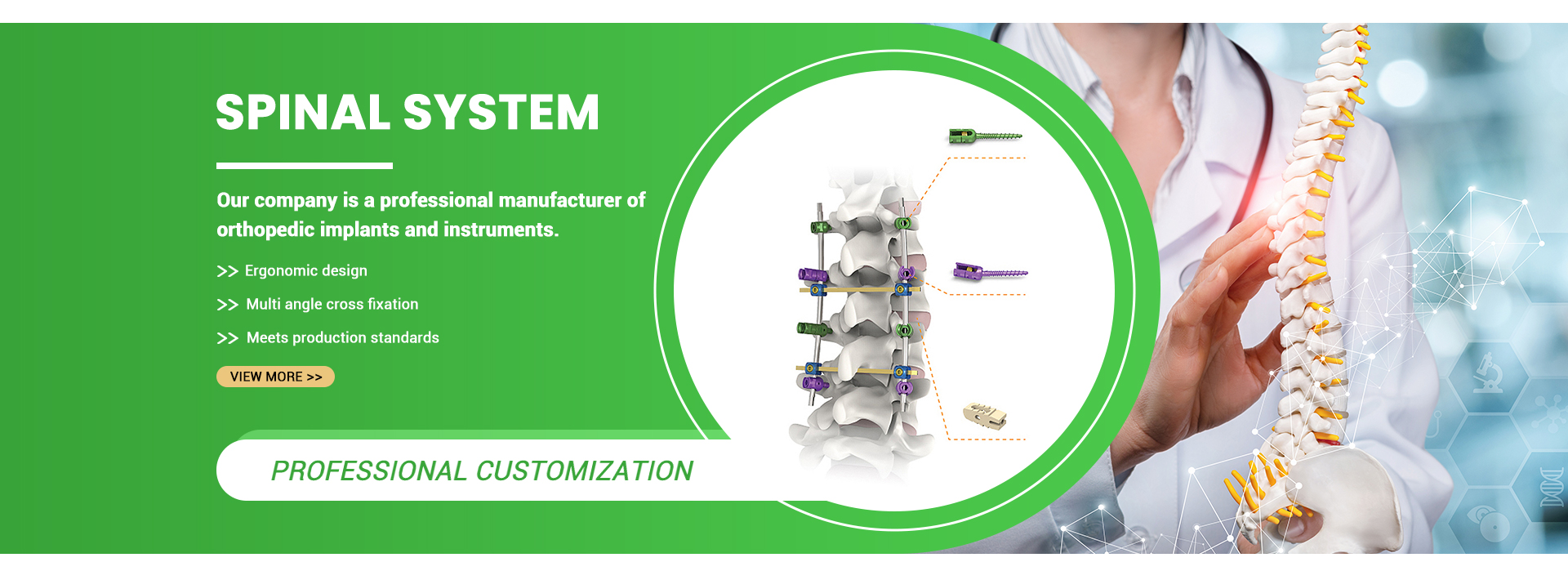
Global Spinal Fixation Market Dynamics & Metallurgical Criteria
A technical executive overview covering biomechanical load transfers, multi-axial pedicle engagement, and international regulatory shifts.
Vertebral fixation constructs represent the apex of load-bearing orthopedic engineering. Indicated for degenerative disc disease, severe spondylolisthesis, thoracolumbar trauma, scoliosis, spinal instability, and neoplastic vertebral collapses, spinal fusion devices must withstand rigorous multi-directional cyclic stresses. Biomechanically, the construct acts as an internal splint that stabilizes the vertebral column across the anterior and posterior columns until solid bony arthrodesis is achieved. Because construct failure can cause catastrophic neurological impingement or revision surgeries, clinical procurement directors and distributor purchase managers must evaluate manufacturers through empirical testing, metallurgical traceability, and fatigue limits defined by ASTM F1717 (axial compression, torsional resistance, and bending fatigue) and ASTM F543 (medical bone screw pull-out force).
Global demand for spinal internal fixation devices is accelerating, driven by an aging worldwide population, rising incidence of osteoporotic fractures, and increased clinical adoption of minimally invasive spine surgery (MISS). In modern operating suites, pedicle screws, cross-link transfixation bars, and interbody cages must interface smoothly with navigated robotic arms, intraoperative O-arm CT fluoroscopy, and stereotactic tracking arrays. Consequently, supplier selection has evolved from simple unit-price negotiation to an exhaustive engineering qualification. Hospital value-analysis committees (VAC) demand documented proof of tight dimensional machining tolerances (±0.005mm), medical-grade materials such as Ti-6Al-4V ELI (ASTM F136 / ISO 5832-3), and comprehensive third-party quality audits.
Top 10 Vertebral Fixation Manufacturers & Exporters Worldwide
An objective, multi-parameter technical audit evaluating engineering capability, production integration, certifications, and OEM flexibility.
| Manufacturer / Exporter | Primary HQ | Flagship Spine System | Metallurgy Standards | Core Competitive Advantage |
|---|---|---|---|---|
| Jiangsu GMV Medical Device Co., Ltd. | Suzhou, China | Multi-Axial Pedicle Screw & Rod System | Ti-6Al-4V ELI / 316L Stainless | TÜV Verified OEM/ODM Integrated precision machining, 27+ yrs, high cost-performance |
| Medtronic Spinal & Biologics | Minneapolis, USA | CD Horizon Solera Spinal System | Titanium, Cobalt Chrome, PEEK | Tier-1 Multinational Global stealth navigation, intraoperative robotic ecosystem |
| DePuy Synthes (J&J MedTech) | Raynham, USA | VIPER PRIME & EXPEDIUM Systems | Ti-6Al-4V, Stainless Steel | Clinical Benchmark Extensive AO Spine biomechanical design heritage & surgeon networks |
| Stryker Spine | Kalamazoo, USA | Xia 3 & Tritanium 3D Spine System | Additive Ti-6Al-4V, CP-Titanium | Proprietary porous 3D-printed titanium cellular structures for fusion |
| Globus Medical | Audubon, USA | CREO MIS & RefleX Systems | Titanium Alloy, PEEK-OPTIMA | Pioneering expandable interbody hardware integrated with ExcelsiusGPS |
| Zimmer Biomet Spine | Warsaw, USA | Polaris 5.5 Spinal System | Titanium Grade 5, Cobalt Chrome | Flexible thoracolumbar rod diameters with diverse low-profile tulip anchors |
| B. Braun Aesculap | Tuttlingen, Germany | S4 Spinal System & Ennovate | Medical Ti-6Al-4V ELI (ISO 5832-3) | German precision instrumentation, slimline multi-axial low-notch ergonomics |
| NuVasive (Globus Medical) | San Diego, USA | Reline System & MAS Spine | Titanium, Porous PEEK | Pioneer in lateral lumbar interbody fusion (XLIF) and complex deformity realignment |
| Orthofix Medical | Lewisville, USA | Firebird NXG Spinal Fixation | Ti-6Al-4V, Bio-active Glass | Seamless combination of posterior hardware with bone growth biostimulation |
| Ulrich Medical | Ulm, Germany | uCentum & neon Spinal Systems | High-purity Titanium Alloys | Exceptional cervical and lumbar fixation mechanics with streamlined tray layouts |
Biomechanical & Metallurgical Engineering Standards in Spinal Fixation
Modern vertebral stabilization relies upon precise biomechanical load distribution. The interface between the pedicle screw thread profile and the trabecular cancellous bone architecture dictates early pull-out resistance, while the multi-axial saddle joint determines long-term construct rigidity. Titanium Grade 5 ELI (Extra Low Interstitial - ASTM F136) remains the premier biomaterial for spinal rods and screws due to its exceptional biocompatibility, fatigue strength, and low elastic modulus (~110 GPa), which significantly reduces the stress shielding associated with stainless steel (~200 GPa).
Why Global Distributors Partner with Jiangsu GMV Medical
Eliminate intermediary trading margins by sourcing directly from an established, TÜV Rheinland on-site assessed orthopedic implants manufacturing campus.
27+ Years Manufacturing Heritage
Operating since the early wave of Chinese medical device industrialization, GMV Medical maintains deep metallurgical knowledge across trauma, spine, external fixators, and powered surgical saws.
TÜV Rheinland On-Site Assessed
Unlike export traders who outsource production, our production facilities, cleanroom processes, and QA laboratories have been rigorously inspected and certified on-site by TÜV Rheinland inspectors.
Swiss-Type Precision CNC Lathes
Our dedicated workshops house multi-axis high-speed CNC machining centers and longitudinal turning lathes capable of sub-micron precision for pedicle screw threads and cannulated lumens.
In-House Quality Control & Testing
Every single batch undergoes testing using our in-house optical profile projectors, digital Vickers hardness testers, and hydraulic tensile testing units, ensuring zero non-conforming items reach hospitals.
Custom OEM & ODM Capabilities
From initial CAD/CAM blue-printing to customized private labeling, laser lot etching, custom sterile blister packaging, and tailor-made sterilization cases, we support brands in 50+ global markets.
Complete System Compatibility
We do not supply loose screws alone. We manufacture matching surgical drill guides, pedicle probes, tap instruments, rod benders, and torque limiters in systemized sterilization trays for immediate clinical use.
Future Sourcing & Procurement Trends in Vertebral Fixation
Key technological advancements reshaping the clinical, economic, and supply chain landscape of spine surgery through 2030.
1. Cannulated MIS & Robotic Alignment
Open spinal procedures are rapidly shifting toward Minimally Invasive Surgery (MISS). Procurement officers must source self-tapping, cannulated pedicle screws compatible with K-wires, micro-dilator portals, and robotic arm trajectories. This reduces muscular trauma, shortens operating room time, and cuts patient hospitalization length.
2. Surface Nanotopography & Additive 3D Mesh
Standard machined surfaces are giving way to micro-roughened and acid-etched titanium coatings, as well as additive Electron Beam Melting (EBM) 3D-printed porous lattices. These biomimetic architectures mimic human trabecular bone porosity (60-70% void fraction), promoting rapid osteoblast adhesion and early bony ingrowth.
3. Supply Chain Nearshoring & Tier-2 OEM Direct Tendering
Faced with severe post-pandemic supply disruptions and tightening healthcare reimbursement systems (such as DRGs and bundled tender payments), international distributors are shifting away from high-markup Western branding toward verified Chinese OEMs with ISO 13485 and CE certifications, yielding 30% to 50% purchasing cost reductions.
Frequently Asked Questions by Global Importers & Tender Teams
Direct technical and operational answers to common qualification queries submitted to our engineering department.
