Featured Orthopedic Systems for Clinical Procurement
Complete anatomical locking plate systems, power osteotomy tools, external fixator configurations, and diagnostic training kits manufactured in Suzhou, Jiangsu with batch-level material certifications.

Lab Teaching Models 3 Parts Human Muscular Skull Skeleton Models for Students
High-precision life-size anatomical skull replica depicting origin and insertion muscle zones. Ideal for cranio-maxillofacial surgical rehearsal, anatomical instruction, and surgical trauma orientation in teaching hospitals.

Small Fragment Orthopedic Upper Limb Instrument Kit Steel Manual Power Source Bone Instruments
Comprehensive 3.5mm/2.7mm small fragment reduction and insertion kit. Includes drill guides, bone taps, depth gauges, torque limiters, and self-holding screwdrivers enclosed in a high-autoclave sterilization container.

Factory Price Metal Sternum Saw Medical Electric Saw Orthopedic Drill Saw CE Certified for Orthopedic Surgical Instruments
High-torque autoclavable electric sagittal and sternum saw designed for trauma surgery and cardiothoracic osteotomy. Features stepless speed control, minimal vibration, and long-life nickel-metal hydride battery packs.

Orthopedic Instruments External Fixator Ringent Rod Coupling
Carbon-fiber/stainless-steel modular ringent clamp for damage-control orthopedics. Allows multi-directional pin-to-rod coupling for severe comminuted open fractures, temporary limb stabilization, and non-union management.

High-Speed Surgical Repair Handpiece for Dental Implants Turbine Power Source Steel Material
Pneumatic high-speed contra-angle handpiece equipped with internal cooling channels. Delivers stable 350,000 RPM precision drilling for oral-maxillofacial reconstructions, mini-plate screw tapping, and osteogenic preparations.

Electric Surgical Dental Implant Tool Box Steel Construction for Dental Handpiece
Heavy-gauge 304 stainless steel instrument enclosure with dual silicon inserts. Engineered to withstand repetitive 134°C vacuum autoclave cycles without thermal warping, ensuring long-term aseptic storage in hospital ORs.

Lab Teaching Models the Separated Human Skull Model of PVC
Didactic 22-part disarticulated cranial bone model made of resilient medical-grade PVC. Illustrates internal sutures, neurovascular foramina, and bone thickness variations essential for orthopedic trauma training programs.
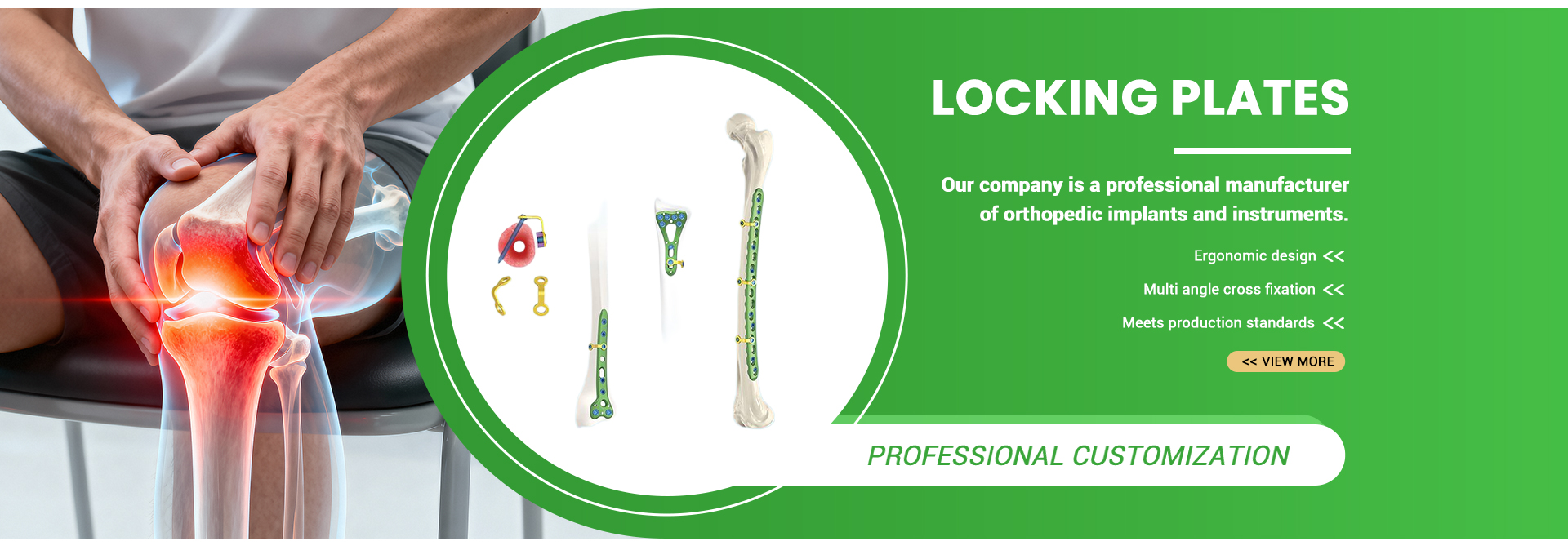
Titanium Variable-Angle & Anatomical Locking Compression Plate System
Grade 5 Ti-6Al-4V ELI pre-contoured plates for distal femur, proximal tibia, and clavicle fractures. Features combi-holes accepting both locked angle-stable and dynamic compression screws with laser-etched batch traceability.
Clinical Landscape & Demand for Locking Plate Systems in Pyongyang
The Democratic People's Republic of Korea has systematically modernized its urban and regional healthcare infrastructure over the past decade, placing special priority on tertiary clinical hubs including the Pyongyang General Hospital, Pyongyang Maternity Hospital, the Bonghwa Clinic, and the Red Cross General Hospital of Korea. In parallel with civic construction, industrial manufacturing, and modernized transport networks across Pyongyang, municipal orthopedic trauma units encounter a substantial caseload of high-energy limb fractures, diaphyseal segmental fractures, and periarticular comminuted trauma.
Historically, conventional osteosynthesis in regional hospitals relied on non-locking compression plates (DCP) and external skeletal transfixation. While functional, dynamic compression plates depend entirely on friction generated between the plate undersurface and the cortical bone, frequently compromising periosteal vascularity, elevating non-union rates, and risking secondary screw loosening in patients with poor bone mineral density. The adoption of modern anatomical Locking Compression Plate (LCP) systems provides definitive clinical advantages:
For centralized procurement organizations, medical equipment import agencies, and international humanitarian medical aid initiatives operating in Pyongyang, the primary imperative is sourcing heavy-duty, standardized implant systems that demonstrate broad clinical versatility. Sourcing complete trauma sets that integrate upper and lower extremity plates with unified screw diameters (such as 3.5mm small fragment and 5.0mm large fragment sets) minimizes surgical inventory churn, streamlines central sterile department logistics, and eliminates operating room delays caused by component mismatches.
Metallurgical Architecture: Titanium Alloy (Ti-6Al-4V ELI) vs. 316L Stainless Steel
Jiangsu GMV Medical Device Co., Ltd. operates state-of-the-art CNC machining lines dedicated to high-precision implant fabrication. When supplying institutional buyers supplying the Pyongyang clinical sector, we offer two distinct, fully certified metallurgical grades, each calibrated for specific clinical economics and biomechanical profiles:
| Evaluation Parameter | Titanium Alloy (Ti-6Al-4V ELI / ISO 5832-3) | Medical Stainless Steel (316L VM / ISO 5832-1) |
|---|---|---|
| Modulus of Elasticity | ~110 GPa (Closer to cortical bone; minimizes stress shielding) | ~200 GPa (Extremely rigid construct; high load-bearing) |
| Biocompatibility & Inertness | Superior passivated TiO₂ layer; minimal cell cytotoxicity | Excellent; proven over decades of clinical osteosynthesis |
| Diagnostic Imaging Artifacts | Minimal scatter on postoperative X-ray, CT, and MRI | Significant metallic scatter; requires artifact reduction |
| Fatigue Resistance | Exceptional cyclic bending life under dynamic walking loads | High ductile capacity; malleable for intraoperative contouring |
| Procurement Budget Tier | Premium Clinical Standard | Cost-Optimized Tender Line |
In traumatic distal femoral fractures or comminuted tibial plateau reconstructions, our Ti-6Al-4V ELI locking plates offer superior fatigue strength against varus collapse during early rehabilitation. Conversely, for large-scale national health tenders requiring maximum unit volume across county-level hospitals, GMV’s high-nitrogen 316L VM stainless steel systems deliver proven metallurgical stability and ductile toughness at a competitive unit cost.
Autoclave & Thermal Sterilization Durability
Hospitals in developing healthcare infrastructures rely predominantly on high-pressure steam autoclaves (121°C to 134°C). All GMV plates undergo advanced electrochemical surface anodization (Type II for titanium) and micro-glass-bead passivation, preventing oxidation discoloration, pitting corrosion, or thread binding over dozens of repetitive sterilization cycles.
Dandong-Sinuiju Cross-Border Transit Logistics
Our manufacturing headquarters in Suzhou, Jiangsu connects directly to premier cross-border freight routes via the Dandong–Sinuiju railway and customs bonded checkpoints. We provide shock-resistant, sealed export packaging, moisture-barrier double-box cartons, and clear bilingual packing lists facilitating smooth transit and customs clearance.
Instrument Interoperability & Ergonomics
Implant failure often traces to worn drive recesses or stripping screw heads. GMV’s Stardrive (Torx) and deep hexagonal screw recesses distribute insertion torque evenly. Our matching surgical toolsets use medical-grade hardened stainless steel (4Cr13 / 17-4PH) ensuring drill sleeves and taps maintain pristine cutting threads after hundreds of procedures.
Jiangsu GMV Medical Device Co., Ltd. - Verified Manufacturing Capability
Unlike export trading intermediaries, Jiangsu GMV Medical Device Co., Ltd. is an established manufacturer operating from Jinfeng Town, Suzhou, Jiangsu Province, China. Spanning over 27 years of dedicated orthopedic implant and surgical instrument fabrication, our manufacturing operations have been thoroughly evaluated on-site by the independent testing body TÜV Rheinland.
Our facility employs 121 skilled technical personnel and operates an integrated production workflow from raw bar stock to finished, cleanroom-packaged medical devices:
International buyers, clinical directors, and third-party inspectors are encouraged to review our full credit profile, audit documentation, and factory video tours, or coordinate direct factory inspection visits to verify our manufacturing capacity before issuing commercial letters of intent.
Frequently Asked Questions for Pyongyang Medical Buyers
Key technical, regulatory, and logistics inquiries addressed for hospital purchasing departments, trade representatives, and medical distributors.
What specific locking plate geometries are recommended for municipal trauma centers?
For broad general surgical and trauma readiness, we recommend our standard core trauma inventory: (1) 3.5mm Distal Radius Volar Locking Plates, (2) 3.5mm Proximal Humerus Philosoph-type Plates, (3) 3.5mm Clavicle S-Form Locking Plates, (4) 4.5/5.0mm Distal Femur Lateral Locking Plates, and (5) 3.5/4.5mm Proximal/Distal Tibia Anatomic Plates. Supplying these with matched self-tapping locking screws and conventional cortical screws in combi-hole configurations enables surgeons to treat over 85% of acute extremity fractures without requesting non-standard instrumentation.
How does GMV ensure cold-welding prevention between titanium plate holes and screws?
Titanium-on-titanium galling or "cold-welding" occurs when excessive friction strips the protective oxide layer during screw locking, making postoperative hardware removal extremely difficult. GMV eliminates this by applying micro-arc surface oxidation to our locking plates combined with hard-anodized screw thread treatments. This introduces a calibrated differential in surface micro-hardness between the male screw thread and female plate thread, ensuring solid angular lock while permitting effortless explantation if necessary.
Can products be private-labeled (OEM) with custom Korean or bilingual laser markings?
Yes. As a primary manufacturer with in-house fiber laser marking equipment, we provide comprehensive OEM/ODM services. We can etch custom institution codes, lot numbers, brand designations, and specific anatomical size indicators in Latin or Korean script directly onto the plate bodies and screw heads. Furthermore, outer packaging, instruction leaflets (IFUs), and autoclave tray labels can be custom-printed to comply with institutional procurement regulations.
What documentation is provided to satisfy customs clearance and medical device validation?
Every dispatch is accompanied by full quality dossier packages: Material Inspection Certificates verifying chemical composition and mechanical tensile properties (matching ASTM F136 / ISO 5832-3 for Titanium or ASTM F138 / ISO 5832-1 for 316L Stainless Steel), Certificate of Conformity (CoC), optical dimension inspection records, and our TÜV Rheinland factory verification report. These documents ensure streamlined processing through regional regulatory audits and customs transit.
What packaging configurations are available for long-distance transit and long-term shelf storage?
We supply implants in two configurations based on client preference: (1) Non-sterile bulk packaging, where implants are individual-bagged, marked with lot numbers, and placed in partitioned graphic boxes intended for hospital central sterile supply department (CSSD) sterilization in customized metal trays; or (2) Class 10,000 cleanroom pre-sterilized double-blister Tyvek packaging (EO gas or Gamma irradiation validated) with 5-year shelf life stability, ensuring immediate readiness for emergency trauma operating rooms.
Initiate Orthopedic System Procurement or OEM Consultation
Connect directly with our engineering and export trade directors to request detailed product catalogs, material verification dossiers, and competitive wholesale pricing tailored to your procurement volume.
Contact Us