
Anatomy & Simulation
Lab Teaching Models 3 Parts Human Muscular Skull Skeleton Models
High-precision medical education models ideal for surgical demonstration, resident osteotomy training, and university anatomical reference.
Direct export configurations engineered to rigorous CE and ISO 13485 standards, supporting tertiary orthopedics across Heraklion and regional Aegean health centers.
High-precision medical education models ideal for surgical demonstration, resident osteotomy training, and university anatomical reference.

High-torque autoclavable surgical saw and drill system featuring variable speeds, tailored for sternotomy and trauma osteotomy.

Multi-pin connection joints and rod-to-rod articulators precision-milled from titanium and hardened alloy for rock-solid mechanical stability.

Dynamic ergonomic turbine handpiece crafted from medical stainless steel, delivering balanced rotation for delicate reconstructive procedures.

Heavy-gauge perforated stainless steel sterilization container system engineered for repeated autoclave duty and organized surgical staging.

Durable PVC anatomical assembly with modular bone sections, designed for cranio-maxillofacial and clinical trauma planning.

Complete modular surgical instrumentation including bone holding forceps, depth gauges, drill guides, and benders in an autoclavable case.
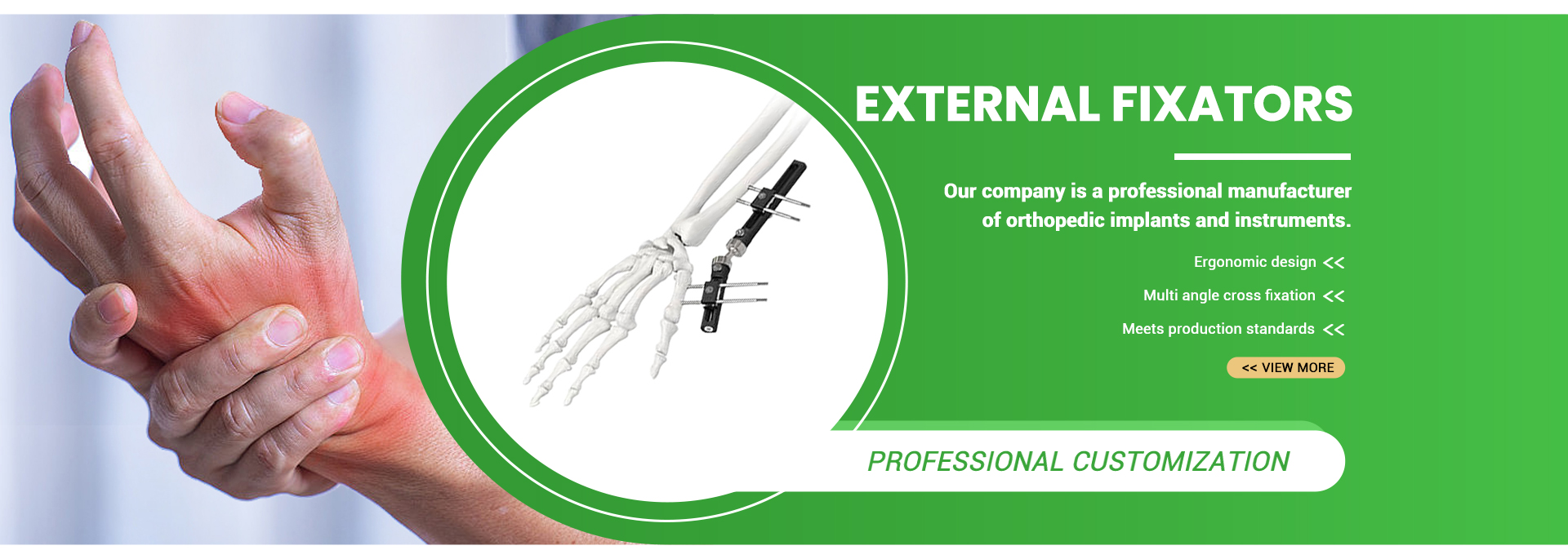
High-rigidity circular and hybrid frames, connecting rods, wire fixation bolts, and tensioners built for acute trauma and distraction osteogenesis.
An engineering overview of circular rings, tensioned transfixion wires, and damage-control stabilization designed for high-stress anatomical environments.
In modern orthopedic reconstructive surgery, external fixator ring systems—originating from the seminal biomechanical principles developed by Professor Gavriil Ilizarov—remain the unrivaled clinical gold standard for managing complex segmental bone loss, acute high-energy open fractures (Gustilo-Anderson Grade IIIB and IIIC), infected non-unions, and progressive limb lengthening via distraction osteogenesis. As an ISO 13485-certified manufacturer supplying medical distributors and public health procurement authorities throughout the Mediterranean, Jiangsu GMV Medical Device Co., Ltd. builds circular fixator systems that harmonize mechanical rigidity with essential axial micro-motion.
Clinical Engineering Paradigm: High-performance ring fixation depends on tension equilibrium. Our rings and multi-hole transfixion clamps maintain tension loads up to 130 kgf across Kirschner wires without structural deflection or thread galling, preserving circumferential stability while allowing controlled axial micromotion that accelerates callus mineralization.
While monolateral cantilever pins provide rapid temporary stabilization in initial triage, their asymmetrical bending moment creates an inherent mechanical disparity across the fracture plane. High cantilever forces often induce pin loosening, stress shielding on the cortex opposite the rail, and secondary displacement under axial loading. In contrast, circular ring fixators employ multiplanar transfixion wires tensioned from 90 to 130 kgf alongside rigid Schanz pins, distributing mechanical stresses symmetrically in three dimensions.
The resulting frame architecture converts shear and torsional forces into constructive axial loading forces during early weight-bearing. This axial compliance stimulates periosteal and endosteal osteogenesis according to Wolff’s Law. By incorporating high-tensile medical-grade aluminum alloy (7075-T6) and radiolucent carbon fiber composites, our external fixator rings achieve an optimal balance of structural stiffness, reduced frame mass, and uncompromised radiographic visualization under fluoroscopy in the operating room.
The selection of raw materials directly dictates clinical outcomes, instrument longevity, and patient comfort. Rings manufactured by GMV Medical are sourced from certified aerospace-grade forged aluminum alloys subjected to hard anodic oxidation, as well as ultra-pure Ti-6Al-4V ELI (Grade 5, ASTM F136) and vacuum arc remelted 316L stainless steel (ASTM F138). Each component undergoes precision tolerance machining within ±0.01 mm on 5-axis CNC machining centers.
Specialized wire-fixation bolts feature precision-machined eccentric grooves that clamp Kirschner wires uniformly without shearing or surface notch creation. This critical design minimizes the risk of intraoperative wire breakage during high-torque tensioning and prevents micro-slippage when patients commence progressive ambulation.
| Material Specification | Density (g/cm³) | Modulus of Elasticity (GPa) | Tensile Strength (MPa) | Radiolucency (C-Arm) | Primary Clinical Indication |
|---|---|---|---|---|---|
| Carbon Fiber Composite | 1.55 – 1.65 | 70 – 140 | 800 – 1200 | 100% Radiolucent (Zero Artifacts) | Intra-articular distal tibia & pediatric lengthening |
| Al-7075-T6 Anodized Alloy | 2.81 | 71.7 | 572 | Semi-Radiopaque (Minimal Obstruction) | Standard trauma rings, 5/8 rings & foot arches |
| Ti-6Al-4V ELI (Grade 5) | 4.43 | 113.8 | 860 – 960 | Radiopaque (Structural Clear Profile) | Schanz pins, wire fixation bolts & load struts |
| Medical-Grade 316L Steel | 8.00 | 193 | 580 – 680 | Fully Radiopaque | High-torque hinge articulations & rod couplings |
Tailored engineering and supply chain solutions configured specifically for Crete's tertiary hospital infrastructure, regional geography, and epidemiological profile.
The University General Hospital of Heraklion (PAGNI) serves as the Level 1 trauma hub for all of Crete and the South Aegean. Our modular circular ring systems provide the variable-angle geometry required for severe Gustilo IIIB/IIIC polytrauma reconstructions and post-resection oncologic bone transfers.
Crete’s North Road Axis (VOAK) and expanding summer tourist transit cause annual spikes in complex multi-fragmentary motor vehicle and two-wheeler collisions. GMV Medical rapid-mounting hybrid rings enable damage-control bridge stabilization within minutes of arrival in the operating suite.
Severe open tibia and ankle crushing injuries from agricultural machinery during the winter harvest season present severe soft-tissue compromise and bone devitalization. Circular frames avoid hardware placement in contaminated zones, allowing simultaneous microvascular flap reconstructions.
Patients airlifted to Heraklion from Rhodes, Karpathos, Kasos, and smaller Cycladic islands require stable, lightweight, zero-maintenance transport immobilization. Carbon-hybrid circular rings maintain rigid mechanical alignment during air transport without excessive frame weight.
Navigating the intersection of EU Medical Device Regulations (EU MDR 2017/745), central public procurement, and modern biological osteosynthesis.
Procurement within the 7th Health Region of Crete (7η ΥΠΕ Κρήτης), covering Heraklion's tertiary facilities—including Venizeleio General Hospital and PAGNI—is increasingly coordinated through Greece's National Central Authority of Health Procurements (EKAPY). Greek hospital tenders place intense emphasis on verifiable technical files, documented clinical safety records, strict batch traceability, and supply chain continuity. GMV Medical works hand-in-hand with licensed Greek distributors, providing comprehensive technical dossiers, CE certification, and rapid customs clearance through Piraeus and Heraklion ports to ensure uninterrupted hospital supply lines.
The regulatory shift from the legacy Medical Device Directive (MDD) to the rigorous European Medical Device Regulation (EU MDR 2017/745) has reshuffled implant availability across Greece. Smaller, non-compliant suppliers have struggled with post-market clinical follow-up (PMCF) requirements and updated risk management standards. Jiangsu GMV Medical Device Co., Ltd. has proactively aligned its entire quality management infrastructure to meet MDR standards, backing every external fixator ring, Schanz screw, and coupling clamp with comprehensive biocompatibility documentation (ISO 10993) and mechanical fatigue testing validations.
Orthopedic clinics throughout Crete are shifting rapidly from static monolateral pins to hybrid ring configurations and 3D computer-assisted spatial correction frames. Modern limb reconstruction surgeons in Heraklion demand universal hardware platforms: rings that can host both tensioned Kirschner transfixion wires for soft metaphyseal bone and self-tapping hydroxyapatite-coated pins for solid diaphyseal fixation. Our modular rings feature universal hole spacing and radiolucent carbon arches designed to interface smoothly with contemporary deformity correction workflows.
Crete’s warm Mediterranean climate, combined with high summer humidity, demands rigorous vigilance against pin-track infections. Pin-site sepsis remains the primary cause of premature external frame removal. To address this challenge, GMV Medical manufactures pins and clamping bolts with ultra-smooth surface finishes (Ra < 0.2 µm) and optional advanced physical vapor deposition (PVD) titanium nitride or antimicrobial coatings. These features minimize bacterial biofilm adhesion (notably against Staphylococcus aureus and Pseudomonas aeruginosa), preserving structural stability during prolonged distraction treatments.
A fully verified, state-of-the-art orthopedic manufacturing facility in Suzhou, China, engineered for precision, high capacity, and tailored OEM/ODM partnerships.
Our complete production plant, QA/QC testing labs, and trade management capabilities have undergone direct on-site verification by TÜV Rheinland, providing European partners with verifiable operational integrity.
Equipped with high-precision CNC Swiss lathes, 5-axis machining centers, and automated wire EDM cutting, our factory enforces strict dimensional tolerances down to ±0.01 mm for reliable component interoperability.
We translate custom surgeon blueprints, specialized ring geometries, and regional clamping preferences into functional surgical-grade instruments, complete with custom laser engraving and branded packaging.
Every single production batch undergoes tensile strength evaluation, torsional yield verification, Rockwell hardness testing, and optical projector inspection to eliminate structural defects before export.
Permanent deep laser marking of unique lot numbers, material batches, and size markings ensures compliance with international Unique Device Identification (UDI) mandates, safeguarding hospital inventory control.
With over two decades exporting to more than 80 countries, our logistics specialists provide dedicated tender support, certificate legalization, and multilingual assistance to Greek orthopedic supply networks.
Addressing the technical, regulatory, and supply chain questions most frequently raised by biomedical procurement officers, distributors, and orthopedic department heads in Crete.
Our circular external fixation systems, including full rings, 5/8 rings, telescopic struts, and transfixion hardware, are manufactured under ISO 13485:2016 and hold CE marking verified against relevant European directives and EU MDR standards. For public tenders through the 7th Health Region of Crete (PAGNI, Venizeleio, Chania, Rethymno), we supply Greek authorized distributors with full technical dossiers, raw material mill test certificates (demonstrating compliance with ASTM F136 for Titanium and ASTM F138 for 316L Stainless Steel), biocompatibility certificates (ISO 10993), and authorized manufacturer declarations.
Yes. Our circular ring fixator platform utilizes unified standard hole diameters (8 mm) and consistent radial pitch intervals across our aluminum alloy, stainless steel, and carbon fiber composite rings. Surgeons at trauma centers can seamlessly construct hybrid frames—for instance, placing a carbon fiber ring across the joint line for unobstructed fluoroscopic monitoring while employing an economical anodized aluminum ring along the diaphyseal segment—using identical bolts, rods, and wire fixation clamps.
Our wire-fixing bolts and slotted clamping bolts are precision CNC-machined from high-strength Ti-6Al-4V ELI or cold-worked surgical stainless steel. They feature an offset channel and micro-serrated gripping bed that distributes clamping torque evenly along the 1.5 mm or 1.8 mm Kirschner wire. This geometry prevents the wire from pinching, flattening, or suffering stress concentrations that could precipitate intraoperative failure during tensioning with mechanical or calibrated dynamometric wire tensioners.
We maintain an extensive buffer stock of finished components—including standard rings (diameters 100 mm to 220 mm), threaded rods, rapid-adjustment hinges, and pin-to-rod clamps—which can ship within 5 to 7 business days via international air cargo directly to Heraklion International Airport (HER) or Athens (ATH). For large-scale hospital tender contracts or custom-engineered ODM instrumentation sets, sea freight dispatch to Piraeus typically takes 22 to 28 days, supported by complete customs documentation.
Galvanic corrosion is an essential clinical concern in island and coastal environments with elevated ambient salinity and humidity. GMV Medical applies specialized surface treatments to eliminate micro-galvanic currents. Our aluminum rings undergo multi-stage hard anodization yielding a dense, chemically inert aluminum oxide barrier exceeding 25 microns in thickness. When titanium Schanz screws interface with anodized aluminum or carbon rings through surgical steel couplings, the non-conductive anodic layer acts as an electrical insulator, preventing surface pitting, ion release, and hardware seizure.
Yes. Central Sterile Services Departments (CSSD) across hospitals in Heraklion often operate with specific autoclave chamber dimensions and tray loading layouts. We engineer and manufacture custom perforated aluminum and stainless steel sterilization cassettes equipped with medical-grade silicone brackets, clear laser-etched component silhouettes, and dedicated compartments for tensioners, wrenches, and spare wire clamps. This speeds up instrument counting, reduces pre-op preparation time, and prolongs hardware life through repeated autoclave cycles.
