Product Catalog & Surgical Inventory
Precision Orthopedic Implants, Modular Handpieces & Instrumentation
Direct manufacturer-level solutions manufactured under TÜV Rheinland verification, certified for complex trauma networks and hospital operating theaters.

Clinical Topography & Localized Application Scenarios in Rijeka, Croatia
The clinical demand for internal fracture fixation devices across Primorje-Gorski Kotar County is deeply shaped by the unique operational topography of Clinical Hospital Centre Rijeka (Klinički bolnički centar Rijeka - KBC Rijeka). As the tertiary referral hub serving Western Croatia—encompassing the Istrian peninsula, the Kvarner Gulf coastline, and the mountainous terrain of Gorski Kotar—trauma surgeons encounter distinct seasonal and logistical stress profiles. Interlocking intramedullary (IM) nails serve as the foundational gold standard for long-bone diaphyseal and metadiaphyseal fractures across this territory.
Throughout peak tourist influx quarters along the coastal highway arteries (A6 and A7 motorways), high-energy polytrauma incidents involving high-speed motor vehicle and maritime collisions necessitate damage control orthopedics (DCO) transitions to definitive reamed intramedullary fixation. Reamed femoral and tibial interlocking nails provide immediate mechanical load-sharing stability, preserving the periosteal biological envelope while accommodating dynamic axial loading. Furthermore, during winter conditions in Gorski Kotar, an escalating demographic of elderly patients with low-energy osteoporotic fragility fractures—particularly proximal third femur trochanteric and pertrochanteric comminuted injuries—demands reconstructive cephalomedullary nails equipped with variable helical blades or dynamic lag screws that inhibit rotational cutout in demineralized cancellous bone beds.
In response to the logistical realities of island transfers via maritime emergency channels (from Krk, Cres, and Lošinj), hospital central sterile supply departments (CSSD) in Rijeka demand robust, standardized instrument trays. Multi-compatible carbon-fiber radiolucent aiming guides and unified distal locking target devices significantly reduce intraoperative fluoroscopy exposure times and eliminate reliance on scattered, fragmented single-use tooling.
Technical Specifications: Titanium Alloy (Ti-6Al-4V ELI) vs. Implant-Grade 316L
Selecting raw material integrity is decisive in mitigating fatigue failure, screw back-out, and peri-implant infection. Below is the empirical comparative matrix benchmarked against ISO 5832 standards for orthopedic manufacturers serving Kvarner trauma surgical centers:
| Biomechanical & Chemical Parameter | Medical Grade Titanium (Ti-6Al-4V ELI / ISO 5832-3) | Implant-Grade Stainless Steel (316L / ISO 5832-1) | Clinical Clinical Outcome in Long-Bone Diaphysis |
|---|---|---|---|
| Elastic Modulus (Stiffness) | 110 - 114 GPa | 200 - 210 GPa | Titanium closely approximates cortical bone (18-20 GPa), drastically minimizing stress shielding and accelerating secondary callus formation. |
| Yield Strength (Tensile) | ≥ 795 MPa | ≥ 690 MPa | High cycle fatigue resistance protects against nail fatigue rupture during non-union intervals or extended weight-bearing delays. |
| Corrosion Resistance & Biocompatibility | Superior passive TiO2 oxide passivation; chemically inert | Good passivated chromium oxide layer; trace nickel leaching risks | Zero adverse soft-tissue irritation, decreased biofilm adherence rates, and completely eliminates nickel sensitivity complications. |
| Diagnostic Artifact Interference (MRI/CT) | Significantly reduced magnetic susceptibility artifacting | Substantial ferromagnetism distortion and diagnostic scattering | Facilitates precise post-operative neurovascular visualization and localized soft tissue necrosis monitoring via 1.5T & 3.0T MRI scanners. |
| Target Sourcing Procurement Model | Elective tertiary centers, multi-trauma KBC emergency units | High-volume institutional tenders, centralized budget tenders | Balances institutional cost frameworks with high-durability performance criteria across public procurement cycles. |
Emerging Sourcing Trends Across Croatia and the European Union Medical Device Landscape
The procurement architecture in Rijeka and throughout the Republic of Croatia has entered an era of rigorous compliance driven by full enforcement of Regulation (EU) 2017/745 (MDR). Hospital tender boards, governed by the Croatian Ministry of Health (Ministarstvo zdravstva) and HALMED (Agencija za lijekove i medicinske proizvode), no longer assess implant contracts solely on nominal CIF price.
First, stringent supply-chain resiliency and post-market surveillance (PMS) require that suppliers provide uninterrupted lot-level traceability. Intramedullary nails must carry high-contrast, laser-annealed UDI-compliant GS1 DataMatrix identifiers capable of surviving repeated autoclaving without surface degradation or corrosion initiation.
Second, there is a strategic shift away from purely generic stainless-steel designs toward anatomic, multi-planar titanium systems. Modern clinical practice in KBC Rijeka favors retrograde and antegrade multi-hole distal configurations with angular stable locking screws. This permits compression, static locking, and dynamization within a single intraoperative framework, drastically reducing revision surgeries in osteopenic trauma patients.
Third, distributor consolidation across the Balkan-Adriatic corridor has accelerated demand for direct OEM partnerships with verified manufacturers. Regional distributors in Rijeka, Zagreb, and Split increasingly bypass European tiered brokerage houses, seeking factory-direct manufacturing that offers documented metallurgical certificates, certified cleanroom sterilization packaging, and customized instrument sets configured directly for their regional hospital tenders.
Enterprise Manufacturing Competencies
Jiangsu GMV Medical Device Co., Ltd. Advantage
Verified precision engineering, certified traceability, and comprehensive OEM/ODM manufacturing under an audited ISO 13485 quality system.
TÜV Rheinland Audited Facility
Our Jinfeng Town, Suzhou manufacturing infrastructure is assessed on-site by TÜV Rheinland. We provide distributors with complete third-party audit reports validating our mechanical testing, cleanroom protocols, and automated manufacturing lines.
Precision CNC Multi-Axis Machining
Equipped with high-precision Swiss-type lathes and 5-axis CNC machining centers, achieving tolerances within ±0.005mm. Seamless cannulation boring ensures smooth guide-wire passage during complex percutaneous reamed procedures.
Rigorous In-House Mechanical Testing
Every production lot undergoes tensile proof load, torque failure, and static/dynamic four-point bending fatigue assessments in our dedicated laboratory. Optical projectors verify thread contours and pitch accuracy before cleanroom transfer.
Flexible OEM / ODM & Private Labeling
We convert clinical specifications or technical CAD drawings into CE/MDR-ready implant sets. Full support for proprietary laser marking, custom barcoding, multilingual labeling, and tailored graphic sterilization cases.
End-to-End Surface Passivation
Advanced chemical de-greasing, ultrasonic bath cleaning, and electrochemical anodization yield an ultra-stable oxide protective layer that enhances cellular osseointegration and virtually eliminates metallic particle shearing during implantation.
Comprehensive Surgical Workflow Sets
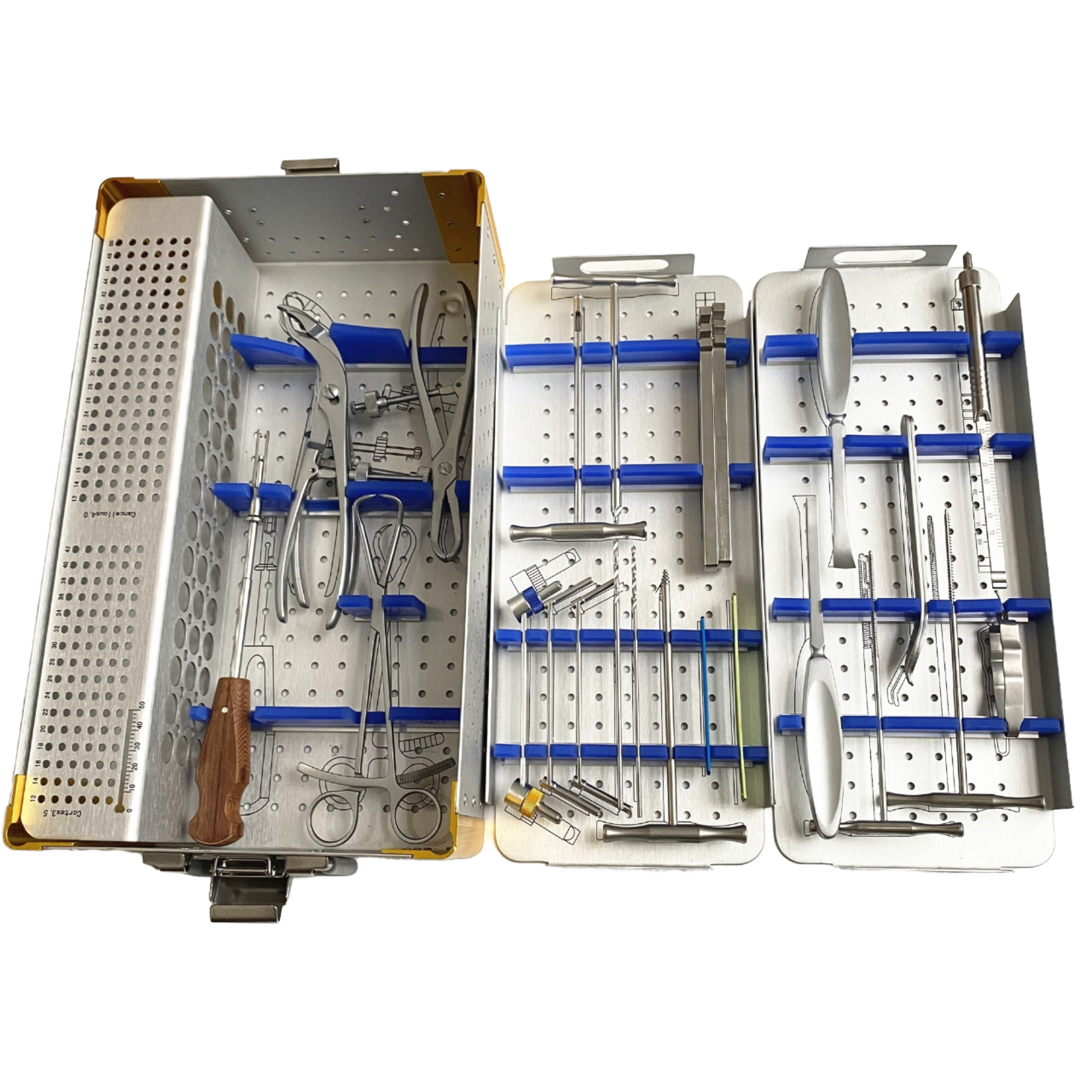
We do not supply loose nails in isolation. GMV delivers holistic trauma solutions: anatomical nails paired with system-matched locking screws, depth gauges, solid reamers, tissue protectors, and carbon-fiber target jigs organized in dedicated trays.
Procurement & Regulatory Inquiry
Frequently Asked Questions for Rijeka Importers & Hospital Contractors
Essential answers regarding compliance, customs documentation, biocompatibility, and logistics for the Croatian healthcare sector.
How does GMV Medical support HALMED and EU MDR registration for Croatian tenders?
We provide full technical documentation dossiers (TD), including ISO 13485 certification, declaration of conformity, biocompatibility reports (ISO 10993 series), process validation records, and raw material mill test certificates. We work closely with our partners' local Authorized Representatives (EC Rep) to guarantee smooth submission to HALMED databases.
What is the typical lead time and customs logistics route into the Port of Rijeka?
For standard catalogue configurations (femoral, tibial, and trochanteric nails), production lead time is 25–35 calendar days. Shipments can be routed via direct ocean freight to the Port of Rijeka (Luka Rijeka) or expedited via air cargo to Zagreb (ZAG) or Ljubljana (LJU) within 5–7 transit days, accompanied by EUR.1/origin documentation.
Can you provide custom-milled distal locking guides matched to existing hospital trays?
Yes. As a verified custom manufacturer with on-site CNC engineering, our CAD/CAM design department can adapt carbon-fiber or titanium targeting jigs to align with institutional preferences, verifying coordinate targeting accuracy via optical coordinate measuring machines (CMM) before mass batch production.
What raw material origin assurances are provided with each production heat?
We exclusively mill surgical implants from certified Ti-6Al-4V ELI (Grade 5, ASTM F136 / ISO 5832-3) and medical-grade 316L (ASTM F138 / ISO 5832-1). Each dispatched lot is accompanied by positive material identification (PMI) chemical spectroscopy reports and mechanical heat certificates guaranteeing zero micro-structural impurities.
