Featured Spinal Fixation & Orthopedic Hardware Systems
Factory-direct medical hardware engineered with tight-tolerance CNC precision, tailored to the clinical requirements of hospitals across Cartagena, Bolívar, and the Caribbean coastline.

Anatomical multi-part cranial osteology model for surgical resident training, neurosurgical simulation, and hospital trauma lab education.

High-precision stainless steel surgical turbine drill providing vibration-free micro-osteotomy and delicate reconstructive bone shaping.

CE-certified heavy-duty electric surgical saw system offering rapid thoracic access, high torque bone resection, and autoclavable reliability.

Medical-grade stainless steel containment cassette with heat-resistant silicone fixtures for streamlined operating room sterilization cycles.

Comprehensive biomechanical teaching replica with mapped cranio-cervical muscle insertions for surgical planning and clinician demos.

Complete surgical case with quick-coupling screwdrivers, depth gauges, self-centering bone forceps, and precision drill guides.

High-tensile clamp connector engineered for damage control orthopedics, emergency polytrauma stabilization, and open fracture alignment.
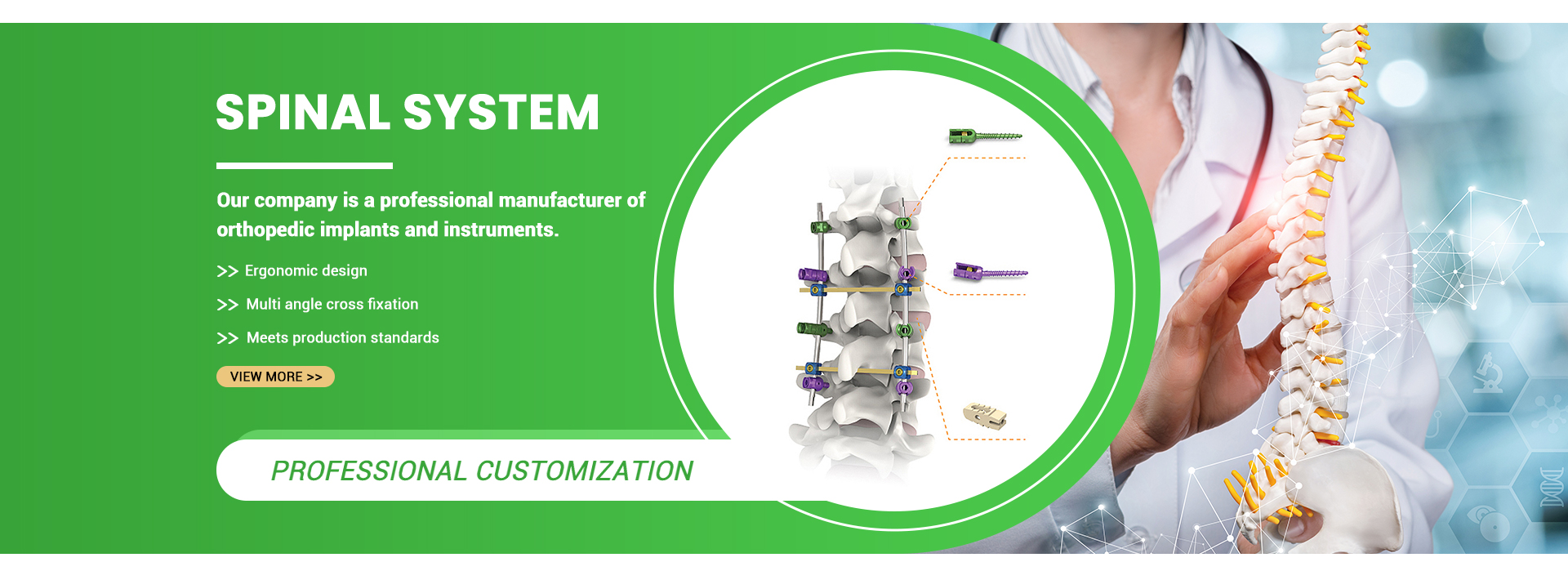
Titanium Ti-6Al-4V ELI monoaxial, polyaxial, and cannulated pedicle screws combined with contoured rods and cross-link stabilization connectors.
Technical Whitepaper: Precision Metallurgy & Biomechanical Anchoring in Spine Fixation
Spinal internal fixation represents one of the most mechanically demanding disciplines in orthopedic surgery. Implants must withstand cyclic axial loading, torsion, and flexion-extension moments while stabilizing unstable spinal segments until solid arthrodesis occurs. For surgical distributors and hospital consortia operating in Cartagena and the broader department of Bolívar, navigating the procurement of spinal implants demands uncompromising attention to metallurgical microstructures, fatigue endurance, and instrumentation ergonomics.
At Jiangsu GMV Medical Device Co., Ltd., our spinal fixation devices are fabricated using medical-grade Titanium Alloy (Grade 5 Ti-6Al-4V ELI conforming to ASTM F136 / ISO 5832-3) and high-purity medical-grade Stainless Steel (316L conforming to ASTM F138 / ISO 5832-1). Ti-6Al-4V ELI (Extra Low Interstitial) offers superior biocompatibility, heightened fatigue strength (surpassing 850 MPa yield stress), and an elastic modulus (~114 GPa) closer to cortical bone compared to stainless steel (~200 GPa). This modulus parity mitigates post-operative stress shielding, promoting uniform load transfer and accelerating bone graft incorporation.
Our pedicle screw engineering incorporates a dual-core conical inner diameter combined with self-tapping reverse buttress threads. This thread geometry converts radial splitting stresses into compressive axial purchase, providing exceptional pull-out resistance—exceeding 1600 N in standard ASTM F543 foam testing models—crucial for osteoporotic patients frequently treated across regional referral clinics. The spherical articulation within our polyaxial screw heads permits multi-planar rod reception up to ±28° (56° total cone), facilitating stress-free screw alignment without excessive rod contouring.
Engineering Material Comparison: Spinal Applications
Detailed technical specification analysis comparing medical-grade alloys utilized in spinal arthrodesis constructs.
| Performance Characteristic | Ti-6Al-4V ELI (ASTM F136) | Medical 316L Stainless (ASTM F138) | PEEK-OPTIMA® Polymers |
|---|---|---|---|
| Elastic Modulus | 110 – 114 GPa (Moderate) | 190 – 210 GPa (High) | 3.5 – 4.0 GPa (Very Close to Cancellous Bone) |
| Yield Strength (Rp 0.2) | ≥ 795 - 860 MPa | ≥ 690 MPa | 130 - 170 MPa |
| Post-Op MRI/CT Artifacts | Minimal Scatter Low interference | Heavy artifact streaking | Radiolucent Complete imaging transparency |
| Biocompatibility / Tissue Response | Exceptional (Active osteointegration) | High biocompatibility | Bio-inert with excellent soft-tissue acceptance |
| Primary Cartagena Clinical Use | Degenerative lumbar fusion, deformity, trauma | Cost-effective public tender trauma cases | Interbody cages (TLIF, PLIF, ALIF, Cervical) |
| Fatigue Limit (10⁷ Cycles) | ≥ 510 MPa | ≥ 380 MPa | High dynamic fatigue tolerance |
Localized Application Scenarios in Cartagena & Bolívar
Understanding the unique clinical dynamics and geographic healthcare landscape of the Colombian Caribbean region.
Tertiary Trauma Referral Centers
Cartagena serves as the primary medical reception hub for high-energy traumatic injuries spanning the northern Bolívar department, Sucre, and Córdoba. Level III and Level IV trauma hospitals, such as the Hospital Universitario del Caribe (HUC) and Clínica Blas de Lezo, handle intense volumes of high-energy motor vehicle crashes from the Troncal de Occidente and industrial workplace accidents from the Mamonal petrochemical corridor. These critical scenarios demand robust thoracolumbar pedicle fixation systems capable of rapid cannulated placement, immediate axial stabilization, and high fatigue endurance.
Medical Tourism & Elective Arthrodesis
Recognized internationally as an elite healthcare destination, Cartagena’s private healthcare institutions—including Clínica MediHelp in Castillogrande and Hospital Serena del Mar—attract patients from across the Caribbean basin, Central America, and North America for elective spine surgery. Minimally invasive transforaminal lumbar interbody fusion (MIS-TLIF), multi-level cervical disc arthroplasty, and scoliosis deformity corrections require low-profile pedicle screw designs with high-definition radiolucent retractors, guaranteeing superior cosmetic healing, shortened hospital stays, and expedited recovery.
Geriatric Spondylolisthesis & Degeneration
The demographic shift in urban Cartagena has amplified the prevalence of lumbar spinal canal stenosis, degenerative spondylolisthesis, and osteoporotic vertebral compression fractures. Surgeons treating older populations require cement-augmented cannulated pedicle screws and fenestrated screw systems that permit controlled polymethylmethacrylate (PMMA) injection. This biomechanical reinforcement secures immediate anchor stability within compromised trabecular bone, preventing late construct subsidence or anterior rod pull-out.
Spine Fixation Development Trends in Cartagena
Key regulatory, clinical, and logistical evolutions governing medical device procurement across Colombia.
Rigorous INVIMA Modernization
The Instituto Nacional de Vigilancia de Medicamentos y Alimentos (INVIMA) has escalated technical sanitary registry requirements (Decreto 4725 de 2005). Importers in Cartagena require suppliers capable of providing exhaustive technical dossiers, biocompatibility data (ISO 10993), sterilization validations, and Free Sale Certificates (CFS) apostilled by the Chinese Ministry of Foreign Affairs.
Minimally Invasive Surgery (MIS)
Surgical trends across major clinics in Bocagrande and Manga are pivoting from open posterior approaches to percutaneous pedicle screw fixation and extreme lateral interbody fusion (XLIF). Minimizing paraspinal muscle stripping decreases post-operative infection risks in tropical climates and accelerates patient discharge.
Procurement Rationalization
With EPS (Entidades Promotoras de Salud) and IPS (Instituciones Prestadoras de Salud) managing budget constraints, Cartagena’s medical distributors are transitioning away from high-markup Western multi-nationals toward verified original equipment manufacturers (OEMs) that deliver equivalent metallurgical quality and international certifications at direct pricing.
Port of Cartagena Logistics
As Colombia's premier maritime logistics hub (Sociedad Portuaria Regional de Cartagena - SPRC), local orthopedic distributors capitalize on direct ocean container shipping from Shanghai or Ningbo, dramatically lowering freight expenditure compared to Bogota-based air cargo transshipment while maintaining emergency air access via Rafael Núñez Airport (CTG).
Why Cartagena Importers & Hospitals Choose GMV Medical
Backing surgical distributors with proven industrial infrastructure, on-site verified production, and end-to-end technical transparency.
Direct Factory, Zero Intermediaries
Jiangsu GMV Medical Device Co., Ltd. operates state-of-the-art production facilities in Jinfeng Town, Zhangjiagang, Suzhou, China. With 121 verified staff members and over 27 years of orthopedic manufacturing focus, our facility gives Cartagena partners direct factory-floor access, guaranteeing transparent pricing structures and uncompromising lead-time control.
TÜV Rheinland On-Site Assessed
Our manufacturing operations, quality management system, and production capabilities have been evaluated on-site by TÜV Rheinland. We maintain ISO 13485:2016 medical device management certification and stringent CE compliance, providing Cartagena regulatory compliance managers with auditable peace of mind for tender qualification.
Swiss DMG Mori & Citizen CNC Machining
Spinal fixation tolerances require micro-precision within microns. Our workshop houses multi-axis Swiss-type Citizen CNC lathes and DMG Mori 5-axis vertical machining centers, allowing complex spiral thread cutouts, cannulated drilling with total concentricity, and ergonomic polyaxial saddle machining without tooling imperfections.
Full In-House Mechanical & Optical Lab
Batch integrity is validated via our comprehensive internal testing facility equipped with micro-hardness testers, electronic universal tensile machines (ASTM F543 torque and pullout validation), and high-precision optical profile projectors to ensure 100% thread contour adherence to surgical technical drawings.
OEM / ODM & Tailored Private Labeling
Empowering Colombian distributors to build local brand equity. We offer comprehensive OEM/ODM solutions: high-definition laser marking of regional trademarks, lot identification for full post-market traceability, custom sterilization graphic cases, and customized packaging compliant with INVIMA labeling rules.
Comprehensive System Matching
Spinal systems cannot fail in the operating suite due to mismatched tolerances. We engineer and manufacture complete ecosystems: screws, rods, cross-links, pedicle probes, awls, tap guides, torque-limiting ratcheting screwdrivers, and counter-torque wrenches—all housed within unified anodized aluminum sterilization containers.
Cartagena Importer & Hospital Buyer FAQs
Common technical, commercial, and regulatory inquiries answered by our international medical device export division.
What regulatory documentation does GMV Medical provide for Colombian INVIMA registration?
What are the typical shipping routes and transit times to the Port of Cartagena?
Can we request customized screw thread designs or specialized MIS instrumentation?
What is the Minimum Order Quantity (MOQ) for distributors in Cartagena?
How does GMV ensure compatibility between spinal implants and surgical instrument sets?
Elevate Your Spinal Hardware Supply Chain in Cartagena
Partner directly with an on-site verified orthopedic manufacturer. Receive complete technical dossiers, full material test certificates, and immediate distributor pricing for Cartagena and Colombian public tenders.
