Orthopedic Systems & Matched Surgical Instrumentation
Manufactured under stringent ISO 13485:2016 quality management frameworks, fully compatible with Hospital de Braga emergency workflows and specialized surgical suites across the Minho province.

Expert Cannulated Tibial Interlocking Intramedullary Nail System (Ti-6Al-4V ELI)
Biomechanical Engineering of Modern Tibial Intramedullary Systems
Tibial shaft fractures (AO/OTA Type 42) remain among the most prevalent high-energy long-bone injuries encountered in clinical traumatology. For regional medical facilities such as Hospital de Braga—serving as the major Level I trauma reference center for the Minho region of northern Portugal—implant stability, rotational resistance, and load-sharing capacity are critical determinants of clinical success. Modern intramedullary nailing represents the indisputable gold standard for diaphyseal stabilization, yet achieving consistent osteosynthesis in proximal-third and distal-third metaphyseal extensions demands an advanced structural architecture that surpasses obsolete cylindrical constructs.
Proximal Herzog Bend & Anatomical Curvature Optimization
The biomechanical success of a tibial intramedullary nail begins at the entry portal. Historically, rigid straight nails introduced excessive hoop stress along the anterior cortex or caused apex-anterior (procurvatum) deformities, particularly when addressing fractures within 5 cm of the tibial plateau. Our tibial nail matrix incorporates an engineered 10.5-degree proximal Herzog bend positioned precisely 48 mm distal to the nail head. This anatomical angle aligns naturally with the safe trajectory through the bare area of the proximal tibia, avoiding damage to the patellar tendon, meniscal horns, and intermeniscal ligaments.
Distally, a 4-degree caudal bend is integrated across the terminal 30 mm of the implant. This subtle curvature prevents anterior cortical impingement during insertion through the narrow medullary isthmus and permits accurate self-centering within the distal metaphysis. When matched with cannulated reamers ranging from 8.5 mm to 13.0 mm (in 0.5 mm increments), our reamed interlocking technique creates an intimate circumferential endosteal contact, optimizing torsional stability while maintaining medullary blood flow reconstitution.
Multi-Planar Multi-Axial Distal & Proximal Locking Architectures
Unstable fractures with severe comminution (AO/OTA 42-C) or metaphyseal split extensions require advanced multi-planar screw trajectories to prevent secondary displacement under early weight-bearing. GMV Medical designs incorporate five distinct proximal locking options and four multi-directional distal locking holes:
• Oblique Proximal Locking: Two proximal oblique holes angled at 45 degrees provide rigid cancellous purchase within the subchondral bone of the tibial plateau, eliminating angular deformation in high proximal metaphyseal fractures.
• Dynamic & Static Medio-Lateral Slots: An integrated 7 mm elongated dynamic slot permits controlled dynamization (up to 5 mm of axial secondary compression) during delayed union phases, without sacrificing rotational constraint.
• Antero-Posterior (AP) and Medio-Lateral (ML) Distal Cross-Locking: Distal holes configured at alternating 90-degree and 45-degree orientations allow rigid stabilization within 1.5 cm of the tibiotalar plafond, effectively converting distal extra-articular pilon-type fractures into stable constructs that accelerate bone callus maturation.
Metallurgical & Structural Comparison Matrix
Healthcare procurement authorities, clinical engineers, and hospital tender evaluation committees throughout the Norte Region of Portugal require transparent material performance metrics. The following comparative data highlights the technical differences between GMV Medical’s Ti-6Al-4V ELI nail systems and standard commercial implant-grade 316L stainless steel alternatives:
| Engineering Attribute | GMV Medical Ti-6Al-4V ELI (Grade 5) | Standard Surgical Stainless (316L / 1.4441) | Clinical / Procurement Significance |
|---|---|---|---|
| Elastic Modulus (GPa) | 105 – 114 GPa | 190 – 210 GPa | Closer to cortical bone (18–22 GPa); drastically reduces stress shielding and cortical bone resorption. |
| Yield Strength (MPa) | ≥ 860 MPa | ≥ 690 MPa | Superior threshold against plastic deformation under sudden traumatic loads or premature weight-bearing. |
| Fatigue Endurance Limit | > 5 × 10⁶ Cycles @ 350 MPa | > 5 × 10⁶ Cycles @ 260 MPa | Enhanced resistance against cyclic load failure in delayed union or hypertrophic non-union presentations. |
| MRI & CT Compatibility | Minimal Artifact; Non-Ferromagnetic | High Susceptibility Artifacts | Ensures clean postoperative MRI/CT neurovascular and soft-tissue evaluation of the lower limb. |
| Surface Passivation | Type II Electrochemical Anodization | Electropolished Chemical Passivation | Generates a micro-textured oxide layer, minimizing fretting corrosion and bacterial biofilm adherence. |
| Regulatory Verification | ISO 13485:2016 / CE MDR Ready / TÜV | Standard Factory ISO Only | Essential for SPMS framework contracts and national hospital tenders under Portuguese health regulations. |
Clinical Application Scenarios in Braga & Northern Portugal
Analyzing local trauma epidemiological patterns, operative practices, and institutional healthcare supply networks across the Minho province.
Polytrauma from Regional Transit Arteries
Braga sits at the convergence of key northern transport arteries (A3, A11, and A28 highways), yielding an elevated incidence of high-energy motor vehicle and industrial polytrauma. GMV Medical’s interlocking tibial nail systems provide rapid, minimally invasive closed reduction capabilities. This damage-control orthopedics approach preserves the surrounding soft-tissue sleeve and reduces surgical operative time under acute resuscitative conditions.
Geriatric Osteoporotic Fracture Care
Consistent with demographics across northern Portugal, regional hospitals face increasing volumes of low-energy fragility fractures in elderly patients with low bone mineral density. Our multi-locking screw configurations, coupled with optional end-caps that convert distal holes into angular-stable locking interfaces, prevent screw back-out and provide rigid anchor points within osteopenic cancellous architecture.
Suprapatellar Semi-Extended Insertion Protocols
Surgical teams at advanced academic orthopedics departments in Braga increasingly transition toward suprapatellar semi-extended nailing techniques. This approach prevents quadriceps disruption and eliminates apex-anterior apex deformities in proximal fractures. GMV Medical supplies extended radiolucent carbon fiber insertion arms and cannulated sleeves specifically engineered for seamless suprapatellar and infrapatellar approaches.
Procurement & Public Tendering Dynamics (SPMS / SNS Portugal)
Procuring orthopedic medical devices in Portugal operates predominantly under the centralized supervision of the Serviços Partilhados do Ministério da Saúde (SPMS) and public hospital administrative boards within the Serviço Nacional de Saúde (SNS). Orthopedic department directors, biomedical engineers, and logistics procurement teams in Braga operate under stringent budgetary discipline, balancing high clinical efficacy with European MDR (Regulation EU 2017/745) regulatory compliance.
By partnering directly with an on-site verified manufacturer like Jiangsu GMV Medical Device Co., Ltd., hospital supply chains bypass compounding intermediary broker markups. Our direct OEM/ODM industrial framework delivers complete technical dossiers, full material lot traceability, and biocompatibility documentation (ISO 10993 series), enabling Portuguese distributors to bid competitively in public tender framework agreements (Acordos-Quadro) while guaranteeing predictable replenishment lead times into the Port of Leixões or Francisco Sá Carneiro Airport (Porto).
Jiangsu GMV Medical Device Co., Ltd.
Operating a state-of-the-art facility in Jinfeng Town, Suzhou, China, GMV Medical stands as a recognized global leader in trauma, spinal, and instrument manufacturing, independently assessed by TÜV Rheinland.
TÜV Rheinland On-Site Audited
Our complete production facility, dimensional verification protocols, and cleanroom packaging systems have undergone thorough on-site assessments by TÜV Rheinland. Procurement committees can verify our factory capacity reports with complete institutional confidence.
In-House 5-Axis Precision Machining
Equipped with high-precision CNC multi-axis turning centers, precision Swiss lathes, slitting machines, and mirror-polishing systems. We enforce micron-level tolerances across all nail cannulations, external flutes, and thread geometries.
Full In-House Testing Laboratory
Every raw material batch undergoes spectral analysis, Rockwell hardness testing, static torsion testing, tensile mechanical assessment, and optical profile projection. We ensure 100% material traceability from certified raw titanium ingot to sterile-packed product.
Rigorous 8-Stage Manufacturing Control Workflow
Our Jinfeng Town production lines execute eight distinct, interconnected quality stages to guarantee consistent tolerances across high-volume production batches:
Raw Material Intake
Inspection of Ti-6Al-4V ELI & 316LVM bars against strict mill test certificates and chemical assay reports.
Precision Slitting
Automated precision cutting of raw stock into uniform billets to minimize internal material stress.
CNC Swiss Machining
High-speed deep drilling of cannulations, Herzog curvature bending, and contouring on 5-axis CNC centers.
Precision Milling
Milling multi-directional locking holes, dynamic slots, and internal threading for end-cap engagement.
Surface Treatment
Automated deburring, mechanical polishing, and Type II anodization to build uniform anti-galling oxide layers.
Fiber Laser Marking
High-contrast, non-corrosive laser marking of UDI barcodes, lot numbers, diameter, and anatomical lengths.
Metrology & QC Lab
100% optical projector dimensional inspection, thread gauge confirmation, and surface roughness testing.
Cleanroom Packaging
Final ultrasonic cleaning, medical-grade double Tyvek pouch sealing, and global export packaging.
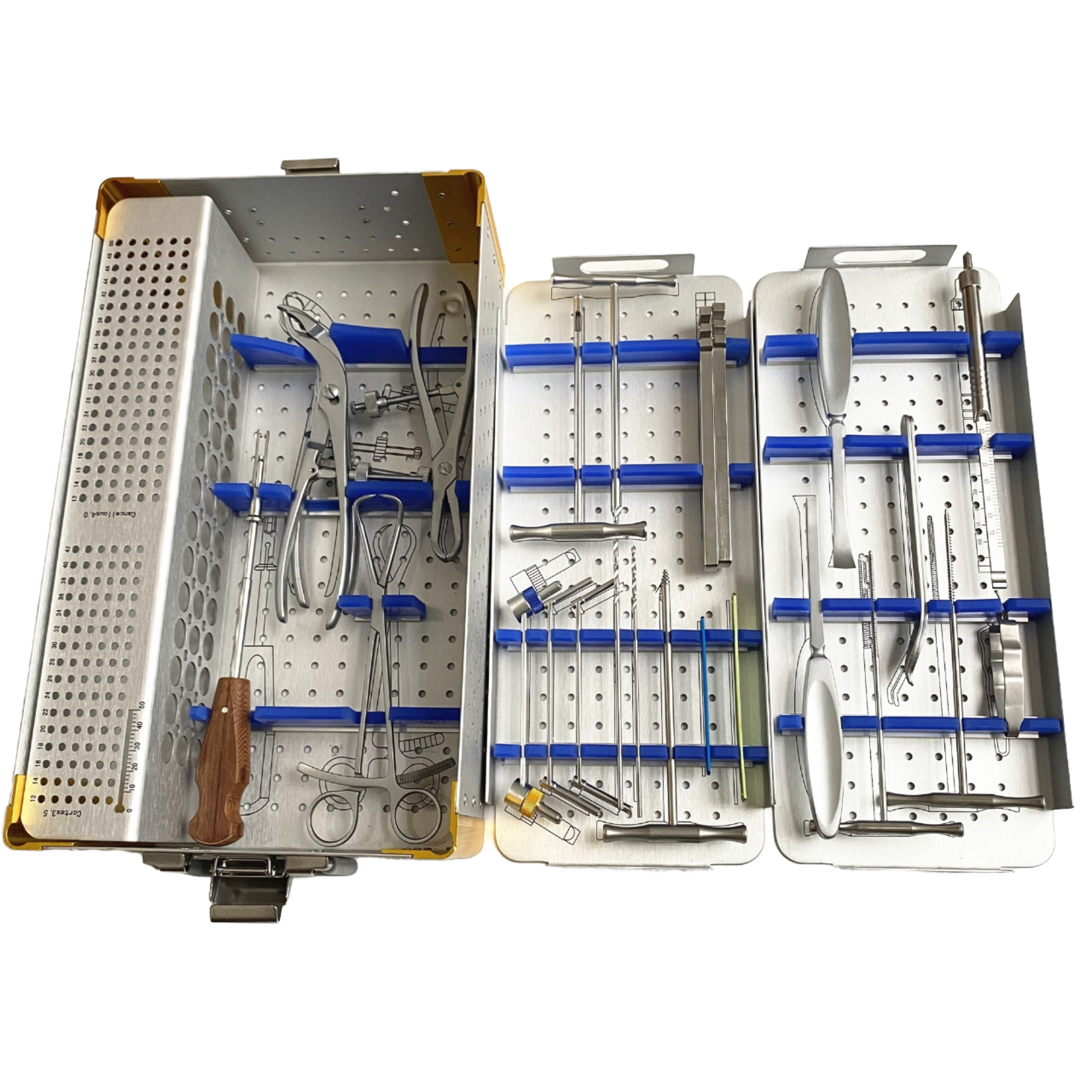
Integrated Tibial Nailing Surgical Instrumentation Sets
Providing seamless interoperability between implants, insertion jigs, flexible reaming shafts, and extraction tools to minimize OR operative turnover time.
A high-performance intramedullary nail is only as effective as the instrumentation used to implant it. Mismatched tolerances between insertion jigs and nail locking holes can cause drill sleeve binding, drill bit deflection, or catastrophic cross-threading of locking screws. GMV Medical manufacturers dedicate complete instrument systems in anodized aluminum sterilization cassettes designed for hospital autoclaving up to 134°C.
Carbon Fiber Radiolucent Targeting Guides
Ensures unobstructed C-arm fluoroscopic visualization of the proximal locking holes and dynamic slot in both AP and lateral views, allowing accurate percutaneous screw placement without radiation scatter.
Monolithic Flexible Reamer Shafts
Engineered with forward-cutting flute geometries and flexible nitinol or specialized stainless shafts that prevent medullary thermal necrosis and reduce peak intramedullary pressure during canal preparation.
Universal Extraction & Revision Kits
Equipped with reverse-thread conical extractors, extension rods, and sliding hammer adaptors, guaranteeing effortless implant removal in non-union revisions or routine hardware removal procedures.
Frequently Asked Questions for Braga & Portuguese Buyers
Addressing regulatory certifications, tender requirements, OEM customization, and delivery logistics for European healthcare markets.
What specific certifications and technical documentation accompany your tibial nails for EU and Portuguese markets?
All GMV Medical tibial nail systems are produced under strict ISO 13485:2016 quality management systems certified by accredited European notified bodies. Our technical construction files incorporate comprehensive biocompatibility testing reports (ISO 10993 series), ASTM F1264 biomechanical fatigue performance testing records, cleanroom bioburden validation, and full material mill test certificates (EN 10204 3.1). These dossiers are fully prepared to support regional distributors in meeting INFARMED (Autoridade Nacional do Medicamento e Produtos de Saúde) registration requirements and public tender submissions under the SPMS framework in Portugal.
Can GMV Medical provide OEM, ODM, and customized private labeling for medical distributors in Northern Portugal?
Yes. We specialize in custom OEM and ODM manufacturing partnerships. We can engrave your customized corporate branding, brand-specific reference codes, and unique device identification (UDI) barcodes using high-precision laser marking machines. Furthermore, we provide design-based customization: if your surgical advisors in Braga or Porto request specific Herzog bend angles, custom flute depths, or specialized multi-hole configurations, our R&D engineering department converts your CAD drawings or physical samples into validated production runs within 4 to 6 weeks.
What are the standard shipping timelines and freight routes from your factory to Braga?
For urgent clinical requirements, standard sample batches, and fast inventory replenishment, we offer expedited air courier delivery via DHL/FedEx directly into Francisco Sá Carneiro Airport (OPO) in Porto, with transit times averaging 4 to 7 business days from dispatch to customs clearance in Braga. For large-scale hospital tender consignments and scheduled container volumes, ocean freight routes run from Shanghai Port directly to the Port of Leixões (Matosinhos/Porto), requiring approximately 28 to 35 transit days. We provide comprehensive export documentation, including certified Certificates of Origin, packing lists, and commercial invoices.
Are GMV Medical tibial nails supplied sterile or non-sterile?
We provide both packaging modalities according to customer demand. For hospital networks with high-capacity central sterile services departments (CSSD)—such as Hospital de Braga—we provide non-sterile systems protected in medical-grade protective sleeves, ready for washing, tray integration, and standard steam autoclaving at 134°C. Alternatively, for private clinics or direct distributor supply, we offer sterile gamma-irradiated or ethylene oxide (EtO) terminal sterilization packaged in double-layer Tyvek blisters with 5-year validated shelf-life barriers.
How does GMV Medical ensure instrument-to-implant precision fit in the operating room?
Unlike third-party traders who source nails and instruments from disconnected suppliers, GMV Medical manufactures both the implants and the matching surgical instrument kits under the same roof. Drill guides, insertion handles, tissue protection sleeves, and interlocking bolts undergo rigorous CMM coordinate measuring and functional mock-assembly testing before release. This eliminates sleeve binding, drill bit deflection, and target misalignment during critical surgical procedures.
Can your factory support video audits or third-party on-site inspections prior to order placement?
Absolutely. We actively invite our international partners, distributor procurement teams, and hospital committees to inspect our facility in Jinfeng Town, Suzhou. We routinely host real-time interactive video audits showcasing our raw material quarantine, CNC production floor, testing laboratory, and packaging lines. You can also commission independent third-party inspection agencies (such as SGS, Bureau Veritas, or TÜV) to verify your production batch prior to export dispatch.
Partner with a Verified Orthopedic Factory for Braga
Direct factory pricing, ISO 13485 quality control, full technical documentation, and rapid OEM customization for trauma implants and instrument kits. Connect with our engineering and export team today.
