Orthopedic Implants & Surgical Hardware Systems
System-matched osteosynthesis hardware, powered cutting devices, anatomical reconstructions, and trauma sets manufactured under sub-micron CNC tolerances for German trauma centers and specialty distributors.

Electric Surgical Dental Implant Tool Box Steel Construction for Dental Handpiece
Medical-grade autoclavable 316L stainless steel storage cassette. Engineered with high-heat resistant silicone dampers to protect delicate powered surgical handpieces during high-pressure steam sterilization cycles.

Lab Teaching Models the Separated Human Skull Model of PVC
High-precision anatomical PVC disarticulated skull model for university orthopedic and maxillofacial residency simulations. Accurate representation of foramen structures, sutures, and bony landmarks.

Factory Price Metal Sternum Saw Medical Electric Saw Orthopedic Drill Saw CE Certified for Orthopedic Surgical Instruments
High-torque, brushless electric surgical saw system. CE certified motor assembly delivering 0–15,000 cpm oscillating rates for clean osteotomies without mechanical chatter or thermal necrosis.

High-Speed Surgical Repair Handpiece for Dental Implants Turbine Power Source Steel Material
Micro-turbine surgical repair instrument with dynamic dynamic balancing. Constructed with high-strength anti-corrosion surgical steel, ensuring sub-micron concentricity during high-load bone restructuring.

Lab Teaching Models 3 Parts Human Muscular Skull Skeleton Models for Students
Anatomical skull and facial musculature training aid illustrating origin and insertion points for reconstructive osteosynthesis, surgical pre-planning, and trauma biomechanics demonstration.

Orthopedic Instruments External Fixator Ringent Rod Coupling
Rapid-assembly snap-fit ringent rod-to-pin coupling for temporary bridging fixation in complex open tibial fractures. High torsional grip strength designed for high-energy polytrauma stabilization.

Small Fragment Orthopedic Upper Limb Instrument Kit Steel Manual Power Source Bone Instruments
Comprehensive surgical instrumentation set featuring self-centering bone forceps, calibrated countersinks, threaded drill sleeves, depth gauges, and star-drive torque limiting screwdrivers.
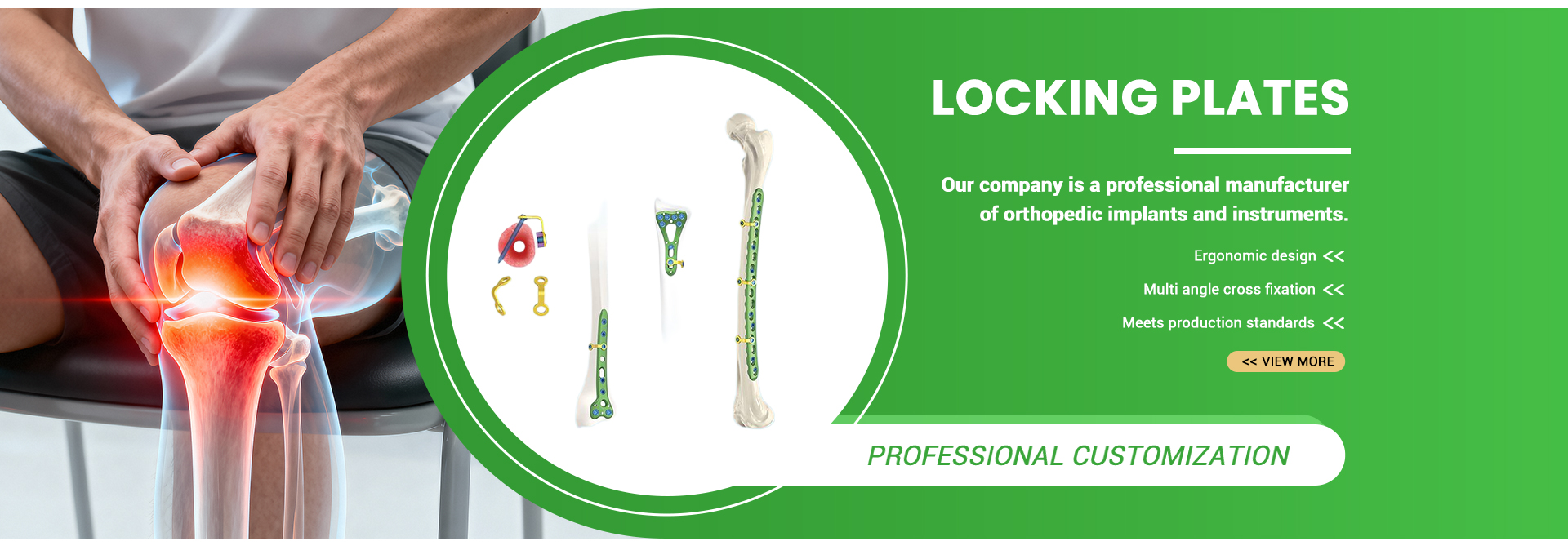
Anatomical Proximal & Distal Tibial Locking Plate Fixation System (Ti-6Al-4V ELI)
Anatomically pre-contoured low-profile plates with combi-holes accepting both variable-angle locking and standard cortical screws. Optimally configured for complex AO/OTA 41, 42, and 43 tibial fractures.
Engineering Biomechanics & Metallurgical Integrity in Tibial Osteosynthesis
A technical treatise on angle-stable fixed-angle constructs, biological osteosynthesis (MIPO), and rigorous ISO/ASTM material validation for orthopedics serving Northern Germany.
1. Biomechanical Superiority of Fixed-Angle Locking Constructs
Conventional non-locking plates rely exclusively on friction generated between the plate and the periosteal bone surface by torque-driven cortical screws. This compression mechanism inevitably causes thermal and mechanical trauma to the periosteum, interrupting local vascular perfusion, elevating infection risks, and accelerating cortical necrosis beneath the plate footprint. In contrast, modern tibial locking plate systems operate as "internal fixators." The rigid threaded engagement between the screw head and the plate hole decouples stability from bone contact, completely preserving the crucial subperiosteal blood supply.
For proximal tibial plateau fractures (Schatzker Types II through VI / AO 41-B and 41-C) and distal tibial pilon fractures (AO 43-A through 43-C), fixed-angle locking screws provide superior resistance against angular collapse, shear loads, and axial displacement. When multi-fragmentary periarticular fractures are loaded during rehabilitation, the fixed mechanical beam construct converts shear forces into compressive loads distributed across the length of the diaphysis, substantially reducing the incidence of secondary varus/valgus collapse even in osteopenic cancellous bone beds.
2. Material Science: Medical Grade Titanium Alloy vs. 316L VM Stainless Steel
Implant material properties directly dictate biomechanical load transfer and postoperative diagnostics. Jiangsu GMV Medical manufactures tibial locking systems primarily from medical-grade wrought Titanium-6Aluminum-4Vanadium Extra Low Interstitial alloy (Ti-6Al-4V ELI conforming to ASTM F136 and ISO 5832-3) and vacuum-melted 316L VM surgical stainless steel (ASTM F138 / ISO 5832-1).
Titanium alloy possesses an elastic modulus of approximately 105–110 GPa—roughly half that of stainless steel (~200–210 GPa). This lower modulus significantly narrows the stiffness gap between the implant and human cortical bone (15–30 GPa), moderating the destructive effects of "stress shielding" and stimulating physiological axial micro-motion (150–300 μm) under dynamic loads, which promotes robust secondary periosteal callus formation. Furthermore, titanium exhibits superior biocompatibility via its spontaneous titanium dioxide (TiO2) passive oxide layer, eliminating localized inflammatory metallosis and producing far fewer distortion artifacts during postoperative Magnetic Resonance Imaging (MRI) and Computed Tomography (CT) scans.
| Performance Characteristic | Ti-6Al-4V ELI (ASTM F136) | 316L VM Stainless Steel (ASTM F138) | Clinical Relevance in Tibial Trauma |
|---|---|---|---|
| Elastic Modulus (Stiffness) | 105 – 112 GPa | 195 – 210 GPa | Lower modulus minimizes stress shielding; encourages secondary bone bridging. |
| Tensile Yield Strength (σy) | ≥ 795 MPa | ≥ 690 MPa | Withstands extreme cyclic bending moments in weight-bearing lower limb bones. |
| Ultimate Tensile Strength | ≥ 860 MPa | ≥ 860 MPa | Guarantees construct safety margins during catastrophic accidental loading. |
| Fatigue Endurance Limit (107 Cycles) | 500 – 620 MPa | 280 – 380 MPa | Critical for delayed-union or non-union scenarios requiring sustained cyclic load survival. |
| MRI / CT Artifact Generation | Minimal Susceptibility Artifacts | Pronounced Metallic Distortion | Vital for precise post-op evaluation of articular congruency and soft tissue status. |
| Tissue Tolerance & Inertness | Superior Biocompatibility (TiO2 Layer) | Moderate; potential nickel sensitivity | Significantly reduces incidence of aseptic hardware intolerance and soft-tissue irritation. |
3. Low-Profile Contouring and Minimally Invasive Percutaneous Osteosynthesis (MIPO)
The anterior and medial surfaces of the human tibia feature minimal muscular coverage, isolated almost entirely beneath subcutaneous fat and delicate skin. Prominent or thick hardware inevitably creates localized soft-tissue tension, skin necrosis, wound dehiscence, and implant exposure—complications historically plaguing traditional large fragment plating. GMV’s modern tibial locking plates feature low-profile, scalloped cross-sections with tapered, rounded tips designed specifically for submuscular insertion. Screw heads seat flush within countersunk combi-holes, preventing mechanical bursitis against the overlying fascia and retinaculum.
Localized Clinical Scenarios in the Hamburg Trauma Network
Targeted solutions developed for specific clinical trauma etiologies encountered across Hamburg's major hospitals, the Port of Hamburg logistics sector, and the North German maritime climate.
Port of Hamburg High-Energy Industrial Crushes
As Europe’s third-largest container port, Hamburg’s maritime cargo hubs, logistics terminals (HHLA, Eurogate), and shipyards experience severe crush injuries and direct high-mass impacts. These frequently result in severe open segmental tibial shaft fractures (AO 42) with profound soft tissue loss. In these scenarios, GMV's damage-control external fixators provide immediate bridging, followed by conversion to our anatomically pre-contoured anterolateral locking plates for definitive anatomical stabilization.
Maritime Slip & Fall Fractures in Wet Hanseatic Climates
Hamburg’s maritime conditions—characterized by persistent cobblestone dampness, black ice along the Elbe and Alster embankments, and rainy cycling surfaces—lead to sudden rotational twist falls. These mechanisms trigger complex spiral tibial fractures coupled with severe distal fibular and pilon lesions. The variable-angle locking screws of our distal tibial medial systems allow surgeons to secure small metaphysical fragments without compromising subchondral bone integrity.
Geriatric Fragility Pilon Fractures in Hanseatic Clinics
Hamburg’s aging population presents an increasing prevalence of osteoporotic low-energy distal tibia fractures. At leading regional geriatric trauma centers such as the University Medical Center Hamburg-Eppendorf (UKE), BG Klinikum Boberg, and the Asklepios Kliniken (St. Georg, Altona, Barmbek), multi-hole divergent locking configurations provide essential pullout resistance in porous bone stock, ensuring early mobilization without hardware migration.
Healthcare Trends & Procurement Drivers in Northern Germany
Navigating the intersection of EU MDR compliance, hospital purchasing alliances, DRG cost optimization, and resilient supply chain logistics.
EU MDR (2017/745) Regulatory Rigor
German notified bodies (such as TÜV SÜD, TÜV Rheinland, DEKRA) have established the most comprehensive audit standards globally under the European Medical Device Regulation. Importers, OEM distributors, and hospital procurement boards in Hamburg now demand rigorous clinical evaluation reports (CER), complete material traceability from raw billet to finished sterilization pouch, and audited Quality Management Systems under EN ISO 13485:2016.
DRG Pricing Pressures & Group Purchasing
Under the German InEK (Institut für das Entgeltsystem im Krankenhaus) DRG framework, hospitals face fixed case reimbursements for orthopedic trauma procedures. Hospital purchasing syndicates operating in the Hanseatic region (such as Prospitalia, Sana Kliniken Einkauf, and clinic-specific GPO tenders) are actively diversifying beyond ultra-high-cost tier-one brands toward verified OEM manufacturers offering identical clinical performance with direct factory economics.
Maritime Supply Chain Optimization
Hamburg’s status as a premier global transshipment center allows direct maritime consolidated freight access from Asian manufacturing centers, slashing intermediate airfreight costs and shortening supply chain cycles. Local distributors maintain bonded inventory within Hamburg free ports, guaranteeing 24-hour replenishment cycles to regional surgical clinics across Schleswig-Holstein, Lower Saxony, and Hamburg.
Manufacturing Authority: Jiangsu GMV Medical Device Co., Ltd.
With over 27 years of dedicated orthopedic manufacturing excellence, Jiangsu GMV operates an independently verified production facility in Jinfeng Town, Suzhou, serving medical distributors worldwide.
TÜV Rheinland On-Site Verification
Our production premises, quality management systems, and trading operations have undergone rigorous on-site audit verification by TÜV Rheinland. We provide global procurement managers with transparent, auditable verification documentation verifying authentic factory capacity rather than trading intermediary markups.
Multi-Axis CNC Precision Engineering
Our workshop houses high-precision CNC multi-axis turning-milling centers, specialized Swiss lathes for bone screw threading, high-speed contour milling units, and automated slitting machines. All thread pitches, locking tapers, and contour radii conform to sub-micron geometric tolerances.
Comprehensive In-House Mechanical Testing Lab
Every raw material batch undergoes material spectroscopy and destructive tensile testing on calibrated electromechanical load frames. Optical projectors verify dimensional pitch accuracy, and automated Rockwell hardness testers ensure that screw head locking mechanisms never strip under maximum torque limits.
Custom OEM/ODM & Private Label Support
We provide full-spectrum engineering customization based on surgeon design sketches, CAD files, or clinical sample benchmarks. Custom fiber laser marking of customer trademarks, UDI (Unique Device Identification) codes, lot identifiers, and CE symbols are applied in-house under cleanroom controls.
Matched System-Platform Compatibility
Rather than providing isolated components, GMV supplies integrated systems: titanium locking plates, self-tapping locking and cortical screws, specialized drill sleeves, countersinks, and sterilization cassettes configured as a turnkey unit, preventing OR sizing mismatches and operational delays.
Dedicated Global Export Logistics
Backed by an established 20-year export track record and a multilingual sales team fluent in 16 languages, GMV provides streamlined customs document preparation, certificates of origin, mill test reports, and flexible delivery terms (FOB, CIF, DDP) straight to Hamburg distribution warehouses.
Frequently Asked Questions by Hamburg Hospital Buyers & Distributors
Technical, regulatory, and commercial insights addressing key procurement inquiries from the German medical device sector.
What regulatory documentation does Jiangsu GMV provide for medical device importation into Germany?
For distributors and procurement managers importing into Hamburg and the broader EU single market, GMV supplies certified material mill analysis sheets (conforming to ISO 5832-3 / ASTM F136 for Ti-6Al-4V ELI and ISO 5832-1 for surgical stainless steel), EN ISO 13485:2016 quality management audit certificates, batch-specific dimensional inspection protocols, bio-burden testing validation records, and full Technical Documentation files aligned with EU MDR (Regulation EU 2017/745) requirements. We work closely with our partners' Authorized European Representatives (EC-REP) to streamline German DIMDI / BfArM notification and UDI data uploads into EUDAMED.
How do GMV tibial locking plate systems ensure compatibility with German operating room instrument sets?
Our tibial locking plate systems utilize standardized universal drive geometries—specifically self-retaining Star-drive (Torx) and precision hex recesses—fully compatible with standard AO/ASIF screwdrivers. Our combi-holes are engineered to standard metric drill bit diameters (e.g., Ø2.5 mm, Ø3.5 mm, and Ø4.3 mm drill bits for 3.5 mm small fragment and 5.0 mm large fragment systems). Additionally, we provide custom or standardized instrument sets housed within perforated aluminum or 316L stainless steel autoclavable cassettes that fit directly into German CSSD (Central Sterile Services Department) washer-disinfectors and steam autoclave chambers.
Can we audit the Jiangsu GMV production facility prior to committing to an OEM contract?
Yes, absolutely. We welcome and actively encourage on-site qualification audits by German technical procurement committees, third-party audit firms, and OEM distributors at our headquarters and manufacturing facility located in Jinfeng Town, Suzhou, Jiangsu Province, China. For clients unable to travel immediately, we host real-time interactive HD video factory audits led by our QA engineering team, walking you through our CNC machining lines, optical inspection cleanrooms, laser marking stations, and mechanical test laboratories.
What is the clinical difference between variable-angle (polyaxial) and fixed-angle tibial locking plates?
Fixed-angle locking plates feature pre-threaded holes that guide screws along a predetermined trajectory. While this creates an extremely rigid construct against shear loads, it limits the surgeon's ability to maneuver around comminuted articular fragments or pre-existing arthroplasty stems. GMV’s multi-axial (variable-angle) locking plate systems allow a conical freedom of ±15 degrees off-axis. This flexibility enables trauma surgeons in busy Hamburg hospitals to target dense subchondral bone anchors and cross-screw articular fractures without losing angular stability when the locking ring engages.
What are the typical lead times and logistics routes from GMV's plant to the Port of Hamburg?
Standard OEM batch production typically requires 30 to 45 business days depending on order customization (laser branding, custom packaging, and technical anodizing). For urgent clinical inventory refills, standard catalogue implants can dispatch via air courier (DHL, FedEx, Lufthansa Cargo) reaching Hamburg Airport (HAM) within 4 to 6 business days. For bulk replenishment and annual container tenders, oceanic container freight dispatches via Shanghai Port directly to the Port of Hamburg (Waltershof / CTA / CTB terminals) with typical maritime transit cycles of 28 to 34 days.
Does GMV support custom packaging, cleanroom blister sealing, and German-language labeling?
Yes. We offer both non-sterile bulk delivery for local hospital sterilization processing and sterile peelable double-blister medical packaging (Tyvek®) under Class 100,000 / ISO Class 7 cleanroom conditions. Packaging labels are customized to display customer branding, batch numbers, sterile indicator dots, expiration dates, DataMatrix UDI barcoding, and multilingual IFU (Instructions for Use) including German text strictly conforming to DIN EN ISO 15223-1 symbols.
