0%

Choosing among the 7 best spinal fixation devices starts with a clinical question: what problem must the construct solve? A Spinal Fixation Device may stabilize vertebrae, support fusion, or help maintain alignment. Its design, materials, and placement differ by spinal region and surgical approach. The right option depends on anatomy, diagnosis, bone quality, and the surgeon’s assessment—not a popularity list.

The need for informed comparison is substantial. The Global Burden of Disease 2021 study, published in The Lancet Rheumatology, estimated that low back pain affected 619 million people worldwide in 2020. It projected 843 million cases by 2050. These figures describe a broad health burden, not the number of people who need fixation surgery. That distinction matters. A device is not a treatment plan.

This overview compares seven commonly discussed device categories, including pedicle screw-rod systems, cervical plates, and interbody cages. It will consider intended use, structural features, typical applications, and practical trade-offs. FDA 510(k) summaries can help readers verify a device’s stated indications and technical characteristics; they do not prove that one device is superior for every patient. Evidence also varies across procedures and patient groups. Some comparisons remain imperfect. That is worth acknowledging. Use this guide as background for a conversation with a qualified spine specialist, not as a substitute for individualized medical advice.
What Are the 7 Best Spinal Fixation Devices?

AANS: More Than 400,000 U.S. Spinal Fusions Are Performed Each Year

What Are the 7 Best Spinal Fixation Devices?

More than 400,000 spinal fusions are performed in the United States each year, according to the American Association of Neurological Surgeons (AANS). That volume makes fixation choices important, but it does not mean one device suits every patient. The AHRQ Healthcare Cost and Utilization Project found that U.S. spinal fusion procedures increased by about 70% between 2001 and 2011. The trend is substantial. It also reflects changing practice, not proof that every fusion is necessary.

Common fixation options include pedicle screw-and-rod systems, interbody cages, anterior plates, posterior plates, hooks, wires, and combined constructs. Surgeons consider the spinal level, bone quality, anatomy, and the reason for surgery when choosing among them. A cage, for example, sits between vertebrae; screws and rods can help stabilize the spine while fusion develops. Device selection is only part of the decision. Risks, alternatives, and expected recovery deserve equal attention. “Best” needs context. AANS annual estimates describe national procedure volume, not individual outcomes, and older AHRQ trend data should not be mistaken for a current forecast. These numbers are useful, but they leave important questions open.

U.S. Spinal Fusion Volume: Annual Benchmark and Equivalent Averages

Using 400,000 procedures per year as a conservative benchmark for the AANS-reported figure of more than 400,000 U.S. spinal fusions annually, the monthly, weekly, and daily values are calculated averages—not actual counts. Procedure volume varies over time. This chart provides context for spinal fixation devices and does not rank device types.

Source: American Association of Neurological Surgeons (AANS), annual U.S. spinal fusion estimate.

How Spinal Fixation Devices Are Evaluated: FDA 510(k) and ASTM F1717

What Are the 7 Best Spinal Fixation Devices?

How Spinal Fixation Devices Are Evaluated: FDA 510(k) and ASTM F1717

There is no single “best” spinal fixation device for every patient. Evaluation starts with its intended use, materials, design, and supporting evidence. FDA 510(k) clearance generally means a device was found substantially equivalent to a legally marketed predicate. It is not a ranking, a guarantee of success, or proof that one device is superior for every procedure. That distinction matters.

ASTM F1717 provides a standardized way to test spinal implant constructs in a laboratory model. Tests may measure stiffness, strength, and fatigue performance under repeated loading. Imagine metal rods and screws secured to synthetic vertebrae, then loaded in controlled conditions. These results help compare tested configurations, but they cannot fully predict healing, pain relief, or performance in a person. Small changes in materials or setup can affect results. I’d avoid treating one chart value as the whole story.

Tips: Check the device’s intended use and compatibility. Ask whether test results match the specific construct being considered. Lab data is useful, but clinical judgment and patient factors still matter.

Seven Device Families: Pedicle Screws, Plates, Cages, Hooks, Wires, and Anchors

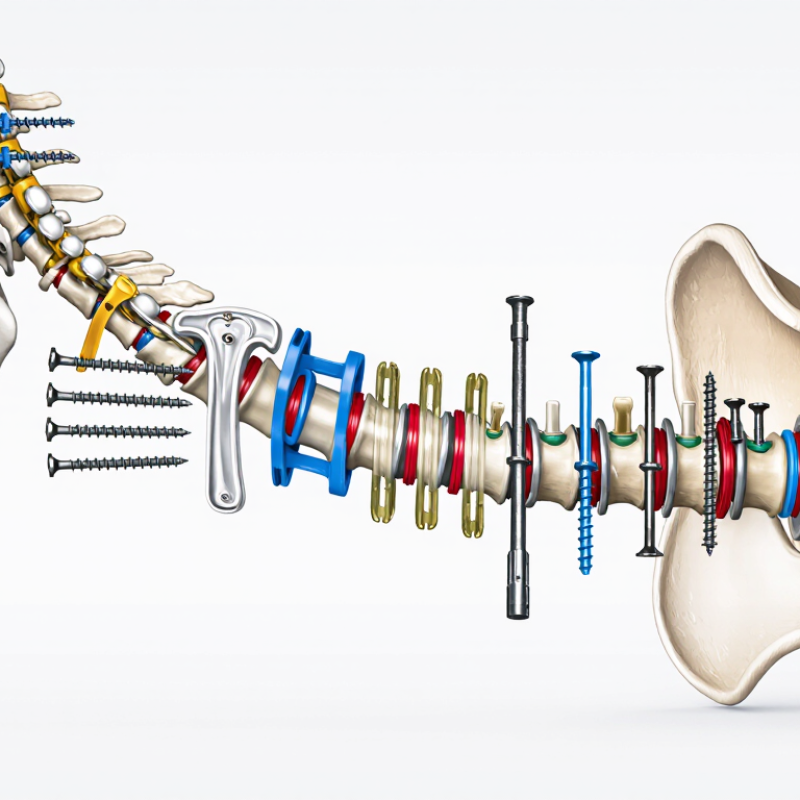
Spinal fixation devices help stabilize selected segments while bone heals or alignment is maintained. Pedicle screws sit within the vertebrae and often connect to rods, which hold the chosen position. Their placement requires careful attention to anatomy and imaging. Fit matters. Plates offer another way to bridge or support vertebrae, particularly in areas where a plate can be secured safely.

Interbody cages are placed between vertebrae after disc removal. They help preserve spacing and provide a surface for bone fusion; their size and position affect fit. Hooks can engage specific parts of the spine when screw placement is unsuitable. Wires provide flexible fixation in selected situations, but they do not offer the same control as rigid screw-and-rod constructs. Anchors attach to bone or other structures, depending on the device design and surgical goal. These categories overlap in practice.

There is no universally “best” device family. Surgeons weigh the spinal level, bone quality, deformity, prior surgery, and the patient’s overall health. A construct that works well in one case may be wrong in another. Even familiar implants have trade-offs: more fixation is not automatically better, and placement choices can be difficult to revise. Patients should ask what each device is intended to do, what alternatives exist, and how healing will be monitored.

How Device Choice Varies by Spinal Region, Stability, and Surgical Approach

The seven options serve different jobs: anterior cervical plates, lateral-mass screws, pedicle screws, connecting rods, interbody cages, laminar hooks, and sublaminar bands. In the neck, a small plate and cage can support the front of the spine after disc removal. Posterior lateral-mass screws may suit a different route. Farther down, pedicle screws linked by rods provide strong control when several lumbar levels need stabilization. Fit matters most. Bone quality matters.

Approach changes the choice. An interbody cage restores disc height from the front, side, or back, while screws and rods may reinforce the construct. Hooks or bands can help in selected cases, but anatomy and bone strength limit their use. The awkward truth: more hardware is not automatically better. AHRQ’s HCUP analysis reported about 413,000 U.S. inpatient spinal fusions in 2008, roughly 2.4 times the 1998 volume. That historical figure shows how widely fusion is used; it does not prove one device works best. Surgeons weigh spinal region, instability, bone quality, and the path to the spine, then balance support against tissue disruption. Small details matter, including screw trajectory and whether a cage sits flush. No implant solves every problem.

Clinical Evidence: Fusion Rates, Complications, and Revision Risks

The “best” spinal fixation device depends on the spinal level, diagnosis, bone quality, and surgical approach. Pedicle screw-and-rod systems, plates, interbody cages, and other fixation options serve different purposes; no single design suits every patient. Clinical studies often report fusion rates, but comparisons can be misleading when patient groups, imaging methods, and follow-up periods differ.

Fusion is not just a clear image on a scan. Surgeons assess bone bridging alongside pain, function, and signs of hardware movement. A cage may support the disc space, while screws and rods limit motion as bone heals. Still, healing can fail. Smoking, diabetes, poor bone density, and multilevel surgery may raise nonunion risk.

Small details matter.

Complications include infection, nerve injury, screw loosening, and hardware breakage. Some patients also develop symptoms near the fused level. Revision surgery may be considered when pain persists, fusion does not occur, or implants shift, but it carries added risks and does not guarantee relief. Evidence should be read carefully: a high fusion rate does not automatically mean fewer complications or revisions. Even good studies leave gaps. Ask how outcomes were measured, how long patients were followed, and whether the results match your condition and goals.

FAQS

What does FDA 510(k) clearance mean for a spinal fixation device?

It generally means the device was found substantially equivalent to a legally marketed device. It is not a ranking. Clearance does not guarantee success or prove superiority.

What does ASTM F1717 testing measure?

It tests spinal implant constructs in a laboratory model, often using synthetic vertebrae, screws, and rods. Tests can measure stiffness, strength, and fatigue under repeated loading. Lab results cannot fully predict healing or pain relief.

What types of spinal fixation devices are used?

Options include pedicle screws and rods, plates, interbody cages, hooks, wires, and anchors. Each has a different role. Fit matters.

Is one device family best for every patient?

No. The choice depends on spinal level, bone quality, diagnosis, prior surgery, and overall health. More fixation is not automatically better.

How do clinicians assess whether fusion has occurred?

They consider bone bridging on scans, along with pain, function, and possible hardware movement. A clear scan alone may not tell the whole story.

What factors may affect the chance of successful fusion?

Smoking, diabetes, low bone density, and multilevel surgery may increase nonunion risk. Individual circumstances differ, so this list is not a personal prediction.

What complications can occur with spinal fixation?

Possible complications include infection, nerve injury, screw loosening, and hardware breakage. Symptoms can also develop near a fused level. Small details matter.

When might revision surgery be considered?

It may be considered when pain persists, fusion does not occur, or implants shift. Revision carries added risks and may not relieve symptoms. It is worth asking what the evidence actually shows.

What questions should patients ask about device testing and outcomes?

Ask whether lab tests match the planned implant configuration, how outcomes were measured, and how long patients were followed. One chart value is not the whole story.

Conclusion

More than 400,000 spinal fusion procedures are performed in the United States each year, according to the AANS, making the selection of fixation technology an important part of surgical planning. A Spinal Fixation Device may include pedicle screws, rods, plates, interbody cages, hooks, wires, or anchors. These device families serve different purposes, such as stabilizing vertebrae, supporting fusion, or maintaining alignment, and their design and testing are assessed through frameworks that may include FDA 510(k) review and ASTM F1717 mechanical testing.

There is no single device that is best for every patient. Choice depends on the spinal region, the degree of stability needed, the surgical approach, and individual clinical factors. Evidence is considered through outcomes such as fusion rates, complications, and the likelihood of revision surgery. Understanding these differences can help explain why surgeons tailor fixation strategies to each procedure rather than relying on a universal solution.

Amelia Grace

Amelia Grace

Amelia Grace is a marketing professional with a strong understanding of her company’s products, services, and the needs of the customers they support. She regularly contributes expert articles to the company website, offering clear explanations, practical insights, and useful guidance to help......